At Gifford Bioscience, we have extensive experience working with novel therapeutics targeting Alzheimer’s, Parkinson’s and Huntington’s disease as well as psychiatric conditions. We characterise receptor pharmacology from membrane preparations through to native, endogenous brain tissue, generating the binding and functional data that drives CNS drug discovery
Case Study
Muscarinic acetylcholine receptors
Muscarinic receptors have become one of the most active targets in psychiatry following the approval of xanomeline-trospium (KarXT) for schizophrenia, the first non-dopaminergic antipsychotic in a generation. With M1 agonism pursued for cognition and M4 agonism for the modulation of striatal dopamine, programmes need binding and functional data generated where these receptors sit at native density and couple to their physiological G-proteins.
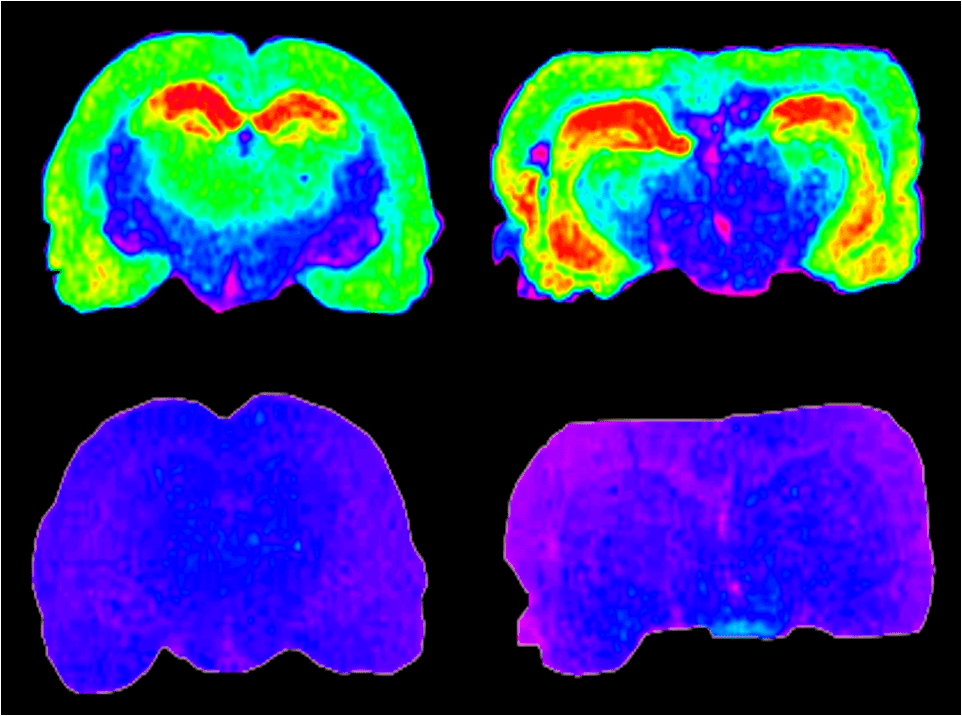
We profiled muscarinic pharmacology in native brain tissue across both binding and function. Competition binding with the antagonist radioligand [3H]QNB quantifies compound affinity, while our Gαq-specific [35S]GTPγS SPA-bead assay confirms agonist-driven receptor activation, together giving a complete affinity-plus-efficacy readout at the native receptor.
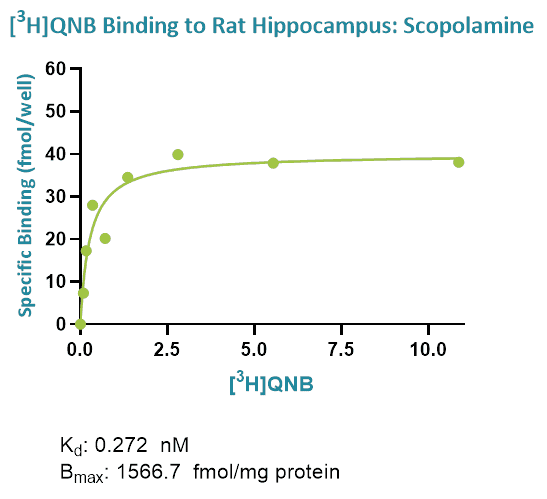
Saturation binding of [3H]QNB to muscarinic receptors in rat hippocampus
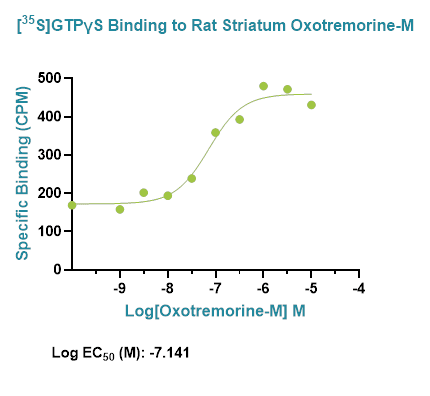
Oxotremorine-M stimulation of Gαq-specific [35S]GTPγS binding in rat striatum
Case Study
Serotonin (5-HT) receptors
The serotonin system is at the centre of the psychedelic renaissance in psychiatry. 5-HT2A is the principal target of psilocybin, DOI and related compounds, several of which are now in late-stage trials for treatment-resistant depression and PTSD. Because the 5-HT family spans fourteen subtypes with overlapping pharmacology, both selectivity and functional efficacy must be measured with care, a compound’s affinity tells only part of the story.
We characterised 5-HT2A pharmacology in native rat brain across binding and function. Competition binding with [3H]ketanserin establishes affinity and regional consistency, while our Gαq-specific [35S]GTPγS assay ranks three psychedelic agonists by functional potency, directly supporting the structure-activity work behind this emerging therapeutic class.
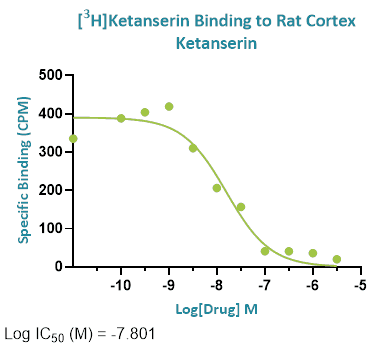
Ketanserin displaces [3H]ketanserin from 5-HT2A receptors in rat cortex
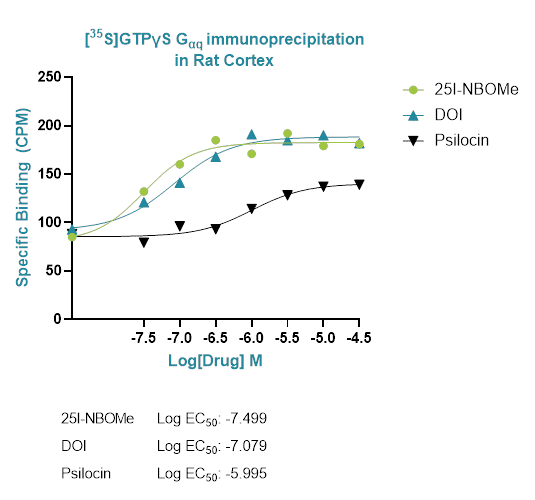
Gαq activation by 25I-NBOMe, DOI and psilocin in rat cortex
Case Study
Methylone-induced neurotransmitter release
We applied our expertise in receptor pharmacology to a study investigating the effect of methylone as a rapid-acting neuroplastogen with greater specificity than MDMA. This finding supports methylone’s potential use in the treatment of PTSD and other neuropsychiatric disorders.
Read the publication here.
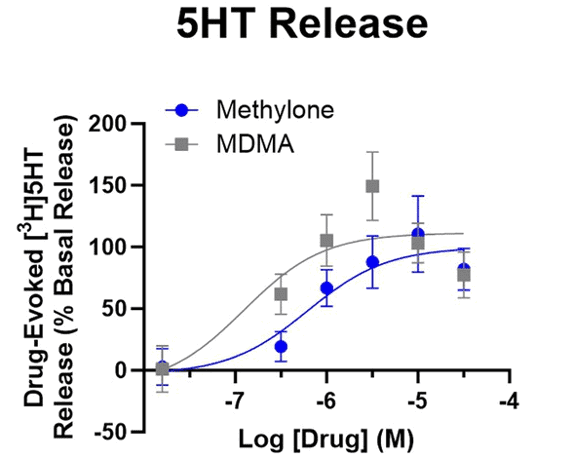
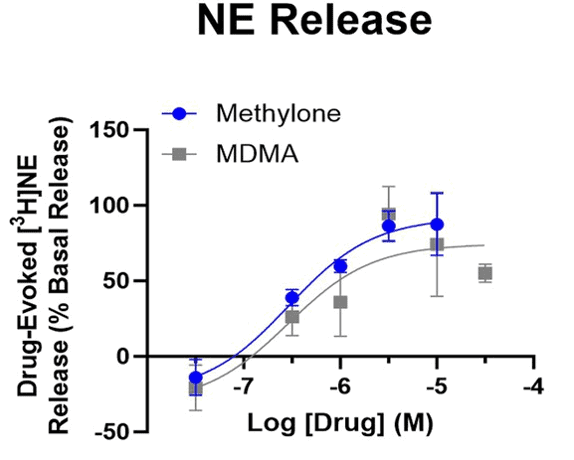
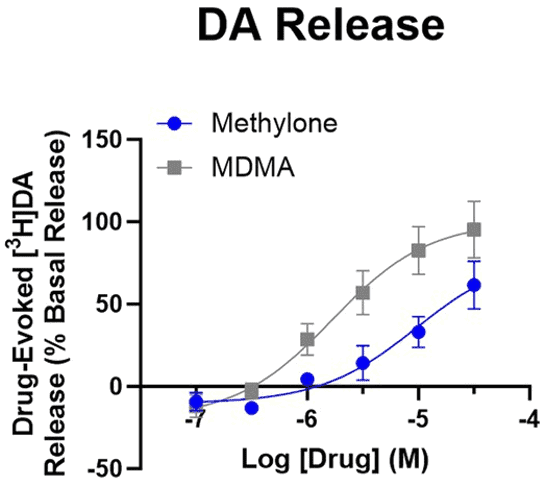
Determination of drug-evoked release of radiolabeled (A) 5HT, (B) NE or (C) DA by methylone or MDMA from rat brain synaptosomes. Data shown are means ± SEM. N = 3 per group.
Radioligand Binding Assays determine receptor-ligand binding affinity (Kd, IC50, Ki), density of binding sites (Bmax) and binding kinetics (kon/koff) in cell lines or to native receptors in human or animal tissue.
Autoradiography and Receptor Occupancy determine target engagement of test drugs to receptors in the animal. These assays visualise and quantify receptor-ligand binding interactions in tissue from naive and drug-treated animals.
SPR assesses binding affinity, inhibition (Kd, IC50, Ki) and kinetics of therapeutics at the target of interest (kon/koff), or investigate protein-protein interactions.
Functional Cell Signalling Assays are radiometric and fluorescence-based assays to profile the physiological effects of compounds by measuring GPCR activation (GTPγS) and downstream signalling (cAMP, Ca2+, phospho-ERK assay) as a result of agonist, antagonist, or inverse agonist treatment (EC50, Emax, IC50).
Radioimmunoassay and ELISAs monitor receptor expression, detect disease markers using radiolabelled antibodies and determine concentration of targets upon drug treatment.
Uptake and Release Assays measure the transport of radiolabeled compounds or neurotransmitters into cells or synaptosomes; the release of the radiolabeled compounds or neurotransmitters and inhibition by test compounds.
What our Partners say about Gifford Bioscience
From initial inquiry to project debrief, it’s our collaborative style that sets us apart. Our 100% PhD level scientists use their deep expertise to help you solve even the most complex of scientific challenges. Visit our testimonials page to see how our Neurology CRO services have helped our partners achieve quality outcomes in the development of heir novel therapeutics.


Copyright © 2026 Gifford Bioscience Limited
Privacy Policy