Receptor Ligand Binding Assay Services
The Key Data for Early Stage Drug Discovery






Gifford Bioscience provides specialist receptor ligand binding assay services for early-stage drug discovery, helping pharmaceutical, biotechnology and academic researchers measure binding affinity, receptor density, binding kinetics, potency and receptor occupancy.
Our scientists can work with human and non-human tissues, cultured cells, cell membranes and recombinant proteins, using a range of complementary receptor pharmacology techniques to generate robust, decision-ready data.
What are Ligand Binding Assays?
Receptor ligand binding assays are techniques used to study the interaction between a ligand and a target protein or receptor.
These assays play an important role in identifying and optimising test compounds by measuring how strongly a ligand binds to its target, how quickly binding occurs and how readily the ligand dissociates.
Ligand binding studies can provide key pharmacological parameters including Kd, Ki, Bmax, kon and koff, helping researchers understand compound affinity, receptor density and binding kinetics during early-stage drug discovery.
Why are Ligand Binding Assays Essential for Early Stage Drug Discovery?
Receptor ligand binding assays can identify compounds with high binding affinity for target proteins and help researchers compare candidate molecules during drug discovery and lead optimisation.
Binding studies can also characterise the rates of ligand association and dissociation, providing insight into binding kinetics and potentially the duration of target engagement.
They can additionally help investigate the specificity of ligand binding, supporting the development of compounds designed to interact with the desired target while reducing unwanted off-target activity.
Combined with functional pharmacology and other complementary techniques, ligand binding assays provide valuable information about how prospective drug candidates interact with their biological targets.
Choosing the Right Receptor Ligand Binding Assay
The most appropriate ligand binding assay depends on the biological target, test compound, sample type and the scientific information required from the study.
At Gifford Bioscience, our receptor pharmacology specialists can design studies using native human or non-human tissue, cultured cells, cell membranes or recombinant proteins.
Depending on the requirements of the project, competition, saturation and kinetic binding studies can be used to determine parameters including Ki, Kd, Bmax, kon and koff.
Complementary techniques including surface plasmon resonance, receptor autoradiography, receptor occupancy and functional assays can provide further insight into target engagement, tissue distribution, binding kinetics and biological activity.
Ligand Binding Assay Study Types
Competition Binding Assays
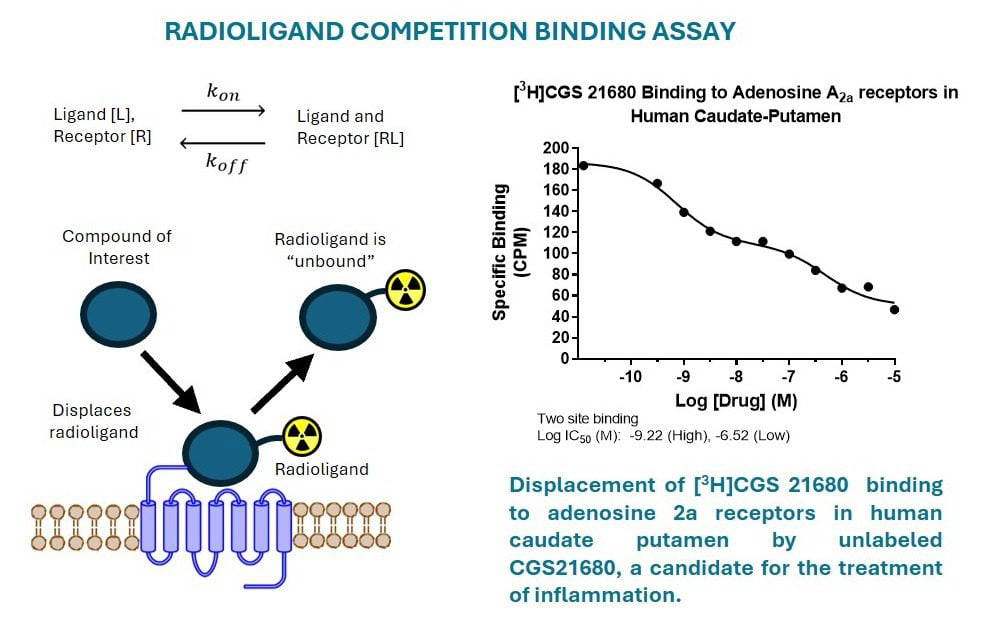
Competition binding assays are commonly used to measure the affinity of test compounds for a receptor.
A test compound competes with a labelled ligand for available receptor binding sites, allowing the concentration-dependent displacement of the labelled ligand to be measured.
These experiments can generate IC50 values and be used to calculate Ki values, helping researchers compare the relative binding affinity of different compounds for the same target.
Competition assays are particularly useful during compound screening and lead optimisation.
Saturation Binding Assays
Saturation binding assays are used to characterise the interaction between a labelled ligand and its receptor across a range of ligand concentrations. These studies can determine:
Kd – the equilibrium dissociation constant and a measure of ligand affinity.
Bmax – the maximum number or density of available receptor binding sites within the sample.
Saturation studies can therefore provide important information about both ligand affinity and receptor expression.
Kinetic Binding Assays
Kinetic binding assays measure how quickly a ligand associates with and dissociates from its target receptor.
These experiments can determine:
kon / ka – the ligand association rate.
koff / kd – the ligand dissociation rate.
Kinetic data can provide information that is not available from equilibrium affinity measurements alone and can help researchers understand the time-dependent characteristics of ligand-receptor interactions.
Ligand Binding Assays: Binding Parameters
- Kd. The dissociation constant indicating the affinity of a ligand for a receptor, with lower values reflecting higher affinity.
- Ki. The inhibition constant representing the potency of an inhibitor, with lower values indicating higher potency.
- kon / ka. The rate at which a ligand binds with a receptor to form a complex.
- koff / kd. The rate at which the ligand dissociates from a receptor.
- Bmax. The maximum binding capacity showing the total number of available binding sites in a sample.
- IC50. The concentration of an inhibitor required to reduce a given biological activity by 50%.
- EC50. The concentration of a drug that produces 50% of its maximum effect.
- Emax. The maximum effect achievable with a drug, regardless of dose.
Receptor Ligand Binding Assays Platforms
Gifford Bioscience provides a range of complementary technologies for investigating ligand-receptor interactions, allowing the most appropriate approach to be selected according to the target, compound and scientific question.
Radioligand Binding Assays
Radioligand binding assays use radiolabelled ligands to measure ligand binding to native or recombinant receptors.
The radioactivity associated with the bound ligand-receptor complex is measured, providing a highly sensitive and well-established method of studying receptor pharmacology.
Radioligand binding assays can be used to:
- Quantify ligand binding in tissues, cells and cell membranes.
- Measure compound affinity and calculate Ki values using competition binding assays.
- Determine ligand affinity using Kd measurements.
- Measure receptor density using Bmax.
- Determine association kinetics (kon) and dissociation kinetics (koff).
- Screen compounds for activity against specific receptor targets.
- Investigate changes in receptor density associated with disease.
- Perform custom radiolabelling or iodination of proteins and ligands where appropriate.
At Gifford Bioscience, radioligand binding studies can be tailored around individual drug discovery programmes and research requirements.
Autoradiography and Receptor Occupancy
Receptor autoradiography uses radiolabelled ligands to visualise the distribution and density of receptor binding sites within tissue sections or cell preparations.
Following incubation with the radioligand, samples are exposed to a phosphor imaging screen or other detection system, allowing the distribution of ligand binding to be visualised and quantified.
Autoradiography can provide valuable spatial information that conventional homogenate binding assays cannot.
Applications can include:
- Investigating receptor distribution within specific tissues or anatomical regions.
- Studying tissue-specific receptor expression.
- Identifying changes in receptor expression associated with diseases such as cancer.
- Comparing receptor density between healthy and diseased tissues.
- Supporting translational pharmacology studies using human disease tissue.
Receptor occupancy studies can also be used to quantify the proportion of receptors occupied following in vivo administration of a test compound, providing information about target exposure and engagement.
Gifford Bioscience has experience sourcing and working with human disease tissue to investigate receptor expression and compound-target interactions in biologically relevant samples.

Click here to
get in touch
Surface Plasmon Resonance (SPR)
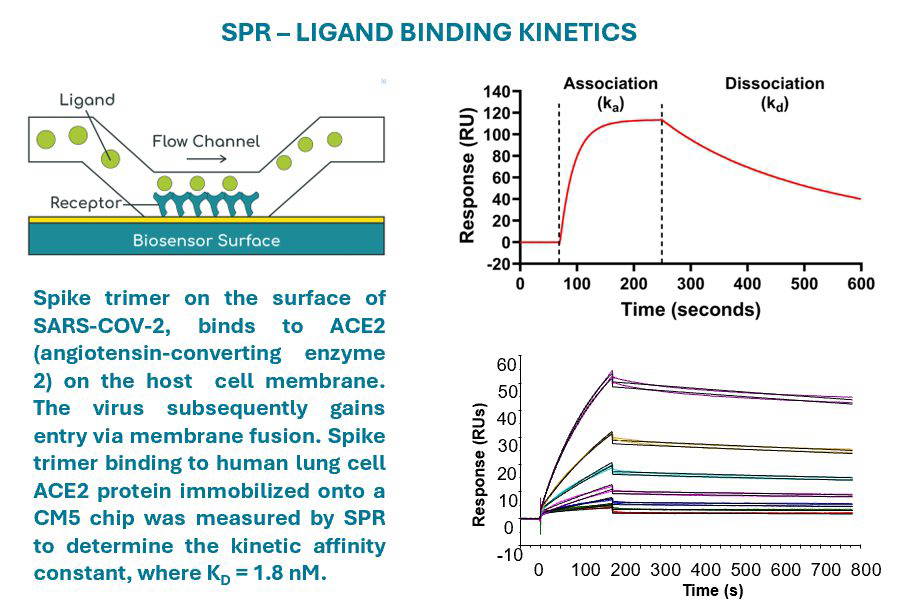
Surface plasmon resonance provides a label-free method of studying molecular interactions in real time.
One interaction partner is immobilised onto a sensor surface and changes in refractive index are measured as another molecule binds and dissociates.
SPR can be used to determine:
- Association rate constants (kon / ka).
- Dissociation rate constants (koff / kd).
- Binding affinity.
- Antibody affinity, including monoclonal antibodies.
- Small molecule binding to purified target proteins.
- Concentration and analyte quantification in biological samples.
Because binding is monitored continuously, SPR can provide detailed kinetic information that complements equilibrium ligand binding measurements.
Functional Ligand Binding Assays
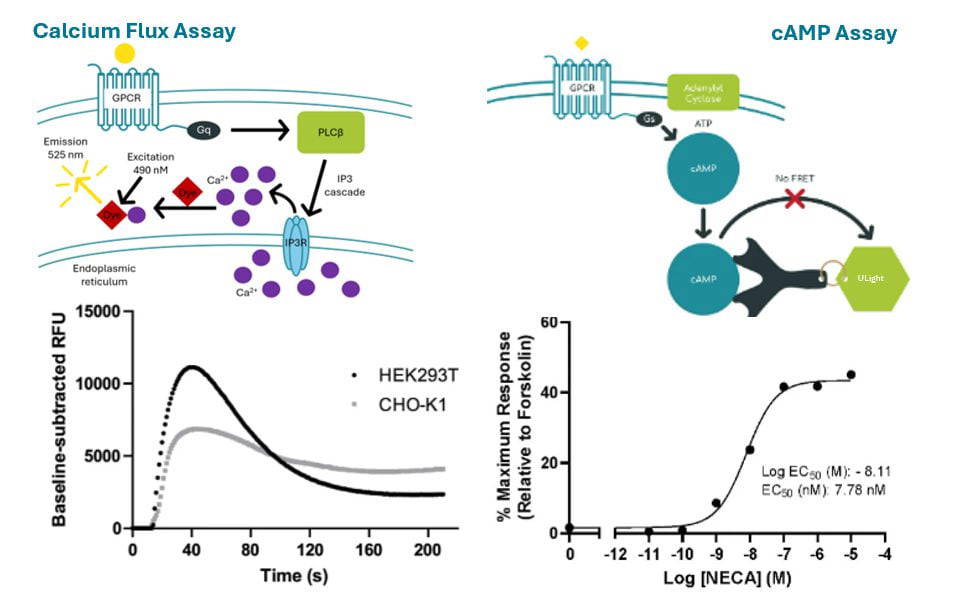
Ligand binding demonstrates whether a compound interacts with a target receptor, but functional assays can help determine what happens as a consequence of that interaction.
At Gifford Bioscience, downstream signalling pathways can be investigated to characterise the functional activity of test compounds.
Functional assays can provide information including:
- Compound potency.
- EC50 and IC50.
- Maximum efficacy or Emax.
- Agonist and antagonist activity.
- Signalling pathway activation.
- Ligand bias.
Techniques can include radiometric methods, fluorescent dyes and antibody-based detection systems.
Examples of receptor signalling assays include:
- GTPγS binding.
- Calcium mobilisation.
- Cyclic AMP production.
- MAP kinase activity.
These approaches can help researchers understand both receptor binding and the resulting biological response.
Radioimmunoassays and ELISAs
Radioimmunoassays and enzyme-linked immunosorbent assays can also be incorporated into receptor pharmacology studies where appropriate.
These techniques can be used to quantify proteins, peptides or other biological markers released as a consequence of receptor activation, or to assess receptor expression at the cell surface.
They can therefore provide complementary information alongside ligand binding and functional pharmacology studies.
Sample Types for Ligand Binding Assays
The biological system selected for a ligand binding assay can have a significant influence on the relevance of the resulting data.
Depending on the target and research question, Gifford Bioscience can perform ligand binding studies using:
Human tissues.
Non-human tissues.
Cultured cells.
Cell membranes.
Recombinant receptors and proteins.
Using native tissue can be particularly valuable where receptor expression, tissue architecture or disease biology may not be fully reproduced within recombinant systems.
Our scientists can help determine the most appropriate experimental system for the target and stage of the drug discovery programme.
Why Choose Gifford Bioscience for Ligand Binding Assays?
Gifford Bioscience is a specialist preclinical contract research organisation focused on receptor pharmacology.
Rather than taking a one-size-fits-all approach, our scientists work with pharmaceutical, biotechnology and academic researchers to design experiments around the biological target, test compound and scientific question being investigated.
Specialist Receptor Pharmacology Expertise
Our work is focused around receptor pharmacology, ligand binding and complementary techniques, providing specialist scientific input throughout study design, assay development, experimentation and data interpretation.
PhD-Level Scientists
Our studies are conducted by experienced PhD scientists who can work directly with clients to understand the scientific objectives of individual drug discovery programmes.
Native Tissue Expertise
Where appropriate, ligand binding studies can be performed using native human and non-human tissues, helping researchers investigate targets within biologically relevant systems.
Multiple Complementary Technologies
Radioligand binding can be combined with techniques including:
Surface plasmon resonance.
Receptor autoradiography.
Receptor occupancy.
Functional pharmacology.
Radioimmunoassays.
ELISAs.
This allows binding affinity, receptor density, kinetics, tissue distribution, target engagement and functional activity to be investigated within a coordinated research programme.
Custom Assay Design
Projects can be developed around individual targets, compounds and research questions rather than being restricted to standardised assay formats.
Our scientists can advise on assay format, biological material and the most appropriate endpoints for the required study.
Ligand Binding Assay FAQs
What type of ligand binding assay do I need?
The most appropriate assay depends on the receptor or target, the characteristics of the test compound, the biological sample and the information required from the study.
Competition assays are commonly used to determine compound affinity, saturation studies can determine Kd and Bmax, while kinetic studies can measure association and dissociation rates.
Complementary technologies such as SPR, autoradiography, receptor occupancy and functional assays may also be appropriate depending on the objectives of the project.
What samples can be used for receptor ligand binding assays?
Ligand binding assays can be performed using a variety of biological systems.
At Gifford Bioscience, studies can be conducted using native human or non-human tissue, cultured cells, cell membranes and recombinant proteins depending on the receptor target and research requirements.
Contact Us
This site is protected by reCAPTCHA. The information you supply will be processed in accordance with the General Data Protection Regulation (EU & UK). For further details, please refer to our Privacy Policy.