
Who Was Ada Lovelace, and What Are We Celebrating?
Born 10 December 1815 into the aristocratic family of the scandalous poet, Lord Byron, Ada Lovelace was a keen scholar in Maths and Science, and overcame barriers set by her tutor who felt, as a woman, she would be putting her health at risk if she were to study advanced material.
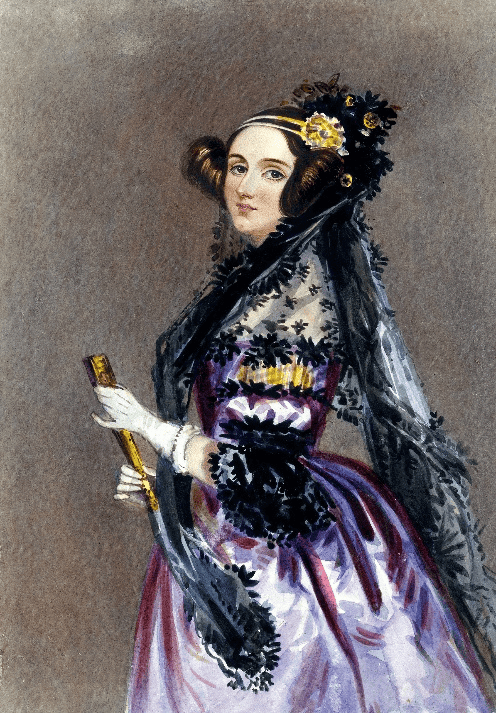
Figure 1. Augusta Ada King (née Byron), Countess of Lovelace (1815-1852).
At the age of 17, she befriended the celebrated mathematician, Charles Babbage, through her mentor, Mary Somerville, a scientist and polymath famous for her work, Mechanism of the Heavens (1831). Babbage had made plans of a novel “Analytical Engine”, which could perform and memorise accurate arithmetic and logical calculations that required large numbers, without which people would rely on handwritten calculation tables that were smattered with errors. In other words, the first general purpose, programmable computer.
In 1842, Lovelace was asked by Babbage to expand on an article describing the Analytical Engine, written originally by Luigi Menabrea, in which she wrote several complete and detailed computer programs along with ideas on other ways in which the machine could be used, including the creation of music. As such, Ada Lovelace is widely considered the first computer programmer, whose work was said to inspire mathematician Alan Turing’s work on modern day computers, nearly a century later.
So, What Is Ada Lovelace Day?
Since 2009, on the second Tuesday of October, Ada Lovelace Day is celebrated globally in education, workplaces, and within the community by commemorating women in STEM through blog posts, conferences, lectures, exhibition displays, and even cream teas! Ada Lovelace Day is an opportunity to give a voice to the women in STEM whose contributions are often overlooked, to inspire the next generation of women to pursue STEM careers, by demonstrating what is possible for them to achieve, and to campaign for women’s rights in the workplace.
At Gifford Bioscience, due to our work in radiometric assays, we are marking Ada Lovelace Day by highlighting the women who were key figures in nuclear physics and medicine, and those within our own company.
Women in STEM: Nuclear Science and Medicine
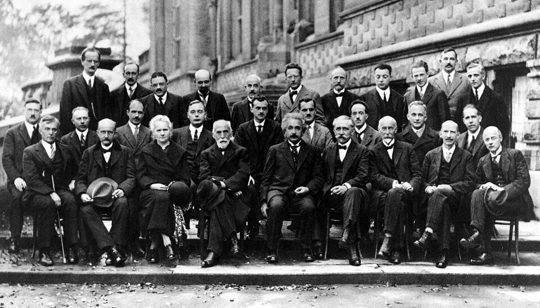
Figure 2. 5th Solvay Conference, 1927. Back row, left to right: A. Piccard, É. Henriot, P. Ehrenfest, É. Herzen, T. de Donder, E. Schrödinger, J. É. Verschaffelt, W. Pauli, W. Heisenberg, R. H. Fowler, L. Brillouin. Middle row, left to right: P. Debye, M. Knudsen, W. L. Bragg, H. A. Kramers, P. Dirac, A. Compton, L. de Broglie, M. Born, N. Bohr. Front row, left to right: I. Langmuir, M. Planck, M. Curie, H. Lorentz, A. Einstein, P. Langevin, C. E. Guye, C. T. R. Wilson, O. W. Richardson.
Historically, nuclear research has been heavily dominated by men. This is aptly depicted in the famous group photograph taken at the 1927 Solvay conference of 29 remarkable physicists and chemists, amongst whom are Albert Einstein, Max Planck, and Erwin Schrödinger, where amongst those 29 individuals, Marie Curie is the only woman present. Yet, she was arguably the most successful out of them all, having been the first female Nobel laureate, she is also the only individual amongst the group to have won two Nobel prizes, and also still remains the only person to have received them in two different sciences: Physics (1903) and Chemistry (1911).
Marie Curie’s achievements most notably include the discovery of the chemical elements polonium and radium, coining the term radioactivity, development of mobile X-ray units during the First World War, and becoming the first female professor at the University of Paris. Unlike Ada Lovelace, Marie Curie came from a more humble beginning, working as a governess and educating herself in her own time, which shows that great achievements can be made despite a person’s background and with application, passion, and determination. The most prominent legacy Marie Curie left in the UK was giving her name to the female-only staffed Marie Curie Hospital (London, UK) to treat female cancer patients using radiology. Although destroyed during the Second World War, a charity was established under the same name to become the leading end of life charity in the UK.
Surely, there must be other women who have contributed to nuclear research?
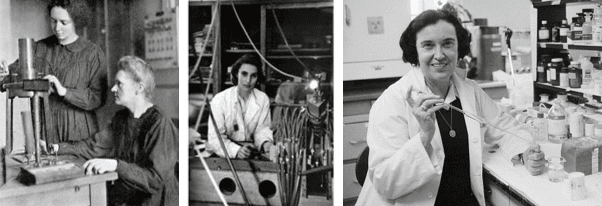
Figure 3. Notable Women in Nuclear Research. Left to right: Irène Joliot-Curie with Marie Curie, Hélène Langevin-Joliot, Rosalyn Sussman Yalow.
In fact, Marie Curie’s daughter, Irène Joliot-Curie, was also a Chemistry Nobel Prize laureate (1935) for the discovery and synthesis of artificial radioactivity, such as phosphorus-30, thus demonstrating that stable elements can be transformed into radioactive isotopes for medical and scientific use. And Irène’s daughter, Hélène Langevin-Joliet, is a prominent activist in advocating women to join and be involved in STEM subjects, and is a firm believer, and living proof, that women do not need to sacrifice their family or livelihoods to pursue such a career.
Rosalyn Sussman Yalow was another notable figure in nuclear research. A medical physicist, Rosalyn was a 1977 Nobel Prize laureate in Physiology or Medicine for developing the novel radioimmunoassay method, the precursor to the ELISA; both of which have been imperative and transformative to the drug research and development processes, medical diagnostics and blood safety.
Like Marie Curie, Rosalyn came from a working background and whilst her parents supported her education, they were adamant on her becoming a teacher. She overcame adversity in a time where people were openly against women succeeding in science and if it wasn’t for her determination to follow her passion in nuclear physics, we may not have gained one of the most important techniques in a scientist’s analytical repertoire. Rosalyn was also an outspoken advocate for women to join in STEM as quoted in her Nobel Prize acceptance speech.
“We [women] must believe in ourselves or no one else will believe in us; we must match our aspirations with the competence, courage and determination to succeed; and we must feel a personal responsibility to ease the path for those who come afterwards.”
Rosalyn Sussman Yalow
Women in STEM: Gifford Bioscience
Ada Lovelace Day is also an opportunity to recognise the women in our own scientific community. Gifford Bioscience is a contract research organisation with a workforce of which 75% is made up of female staff members. Therefore, it is only fitting to hear their career stories in STEM.
Sarah Routledge, Ph.D.
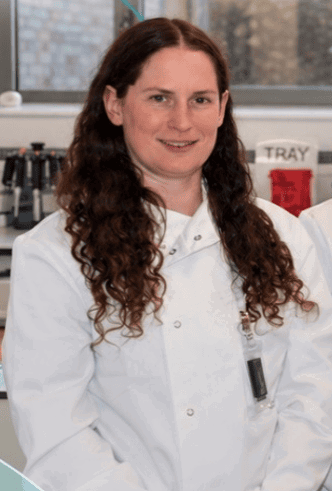 “Biology was my favourite subject at school, and I was fascinated by the complexities of the human body functions. This interest developed into a desire to understand the causes and mechanisms of disease and, ultimately, to improve healthcare.
I completed a BSc in Applied and Human Biology in 2008, followed by a PhD in 2012, both at Aston University. My research project working on recombinant protein expression in yeast first introduced me to GPCRs, radioligand binding and receptor pharmacology. I continued to work on GPCRs in a post-doctoral research position at Aston in collaboration with the University of Birmingham. At the Universities of Warwick and Cambridge, I investigated the role of accessory proteins in signalling bias at Family B GPCRs. I next completed a project with academic and industrial partners across Europe to understand the toxic effects of solvents upon commercial microbes, using liposomes as model membranes and mass spectrometry to study changes to microbe lipid composition.
I joined Gifford Bioscience in 2021 as a Senior Scientist and was appointed a Principal Investigator in 2023. I am now applying the knowledge and skills to develop endogenous functional assays to assist early drug discovery pharmaceutical companies in understanding how their compounds function in native environments for the best clinical outcomes.”
Christine Yu, MSc
 “I wanted to be a vet when I was younger, so I pursued a BSc in Bioveterinary Science at the Royal Veterinary College in London. However, I was swayed from this path during a project I undertook as part of my degree, and instead my career focus shifted to go into research and development. This and my scientific interests in immunology and CNS research led me to undertake an MSc in Infectious Diseases at the London School of Hygiene & Tropical Medicine.
After being in academia, I decided that I wanted to work in research and development in an industrial setting, immediately after finishing my degree. I joined Gifford Bioscience in September 2021 as Operations Officer and continue to enjoy the challenges my role brings.”
Rebecca Brindley, Ph.D.
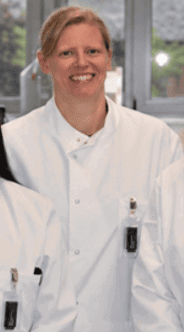 “I obtained both my undergraduate degree and my Ph.D. in Biomedical Science from the University of Sheffield and I decided to pursue an academic career.
My academic research led me to travelling and living in the USA, first at Vanderbilt University, in Nashville, Tennessee, and then Cooper Medical School of Rowan University in Camden, New Jersey. As an academic, my research interests were in regulation of ion channels and neurosecretion.
I relocated back to the UK and decided to go into industry where I joined Gifford Bioscience in 2022 as a Senior Scientist. In my current role, I enjoy the variety of running receptor pharmacology studies on a broad range of therapeutics and target classes, with a focus on developing assays to measure binding kinetics by surface plasmon resonance (SPR).”
Clare Box, Ph.D.
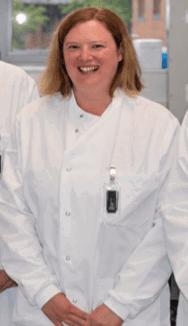 “I remember being about 10 years old and watching a forensic documentary and thinking that I wanted to be exactly like the people in the white lab coats. I did a BSc in Biomedical Science at Lancaster University, including a 1-year placement at Royal Lancaster Infirmary, training to be a biomedical scientist and completing my HCPC portfolio.
However, I decided to do a Ph.D. at the University of Birmingham, with the title, ‘Interactions between platelets and platelet derived microvesicles in inflammation’. I used flow cytometry to look at how platelets interacted with monocytes in whole blood. I then used a model to look at how these aggregates interacted with (HUVEC) endothelial cells under healthy or inflammatory conditions.
Following my Ph.D. I remained at the University of Birmingham to do a post doc where I worked as part of a much wider drug discovery team on structure-aided discovery of CaMK1D kinase inhibitors as targeted therapeutic agents for breast cancer. I ran the SPR (surface plasmon resonance), testing the small molecules produced by the chemists on the team against our target of CaMK1D, and later, the cell-based assays.
I joined Gifford Bioscience in October 2018 where I am now Senior Scientist and Chief of Staff.”
Melissa Finlay, Ph.D.
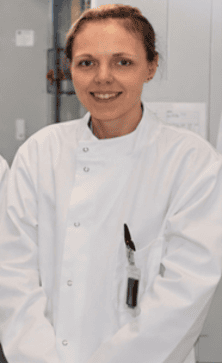 “When I was 11 years old, my Mum was receiving chemotherapy for breast cancer treatment, and the side effects were terrible. But learning how effective the treatment was in clearing her cancer, I knew I wanted to learn more about how the drugs and the human body worked, and whether chemotherapy could be made more effective.
I got an MSci Pharmacology degree from the University of Aberdeen in 2016, which included a 1-year placement in a biotech, Cytosystems Ltd., helping to develop a urinary cytology-based bladder cancer diagnostic test. During my degree I gained an interest in other areas of medical research, like animal replacement research, bone biology, neurology, and metabolic diseases.
I worked in GSK as a technician and then as an assistant scientist at Charles River Laboratories before pursuing a PhD at the University of Birmingham researching into non-animal methods of bone cell culture from 2019-2023. I was a post doc carrying on my PhD work as well as working as an advisory scientist as part of a wider innovation project to accelerate medical device development from bench to bedside. I returned to working in industry, joining Gifford Bioscience as an Associate Scientist in July 2025.”
Get Involved
STEM is open to everyone and anyone; careers in STEM can originate from sheer interest in the subjects, to personal experiences, from learning about influential figures, or by complete chance, it doesn’t have to begin from a life changing moment. And anyone can contribute or be involved in Ada Lovelace Day and STEM; any gender, any age, any career, any background. Attending an Ada Lovelace Day event or a women in STEM exhibit in a museum, writing or reading a biographical blog of a female STEM figure, teaching a women in STEM lesson or learning one new thing and telling someone else about STEM are all acts that raise awareness of the women that have been and still are less talked about or do not receive the same recognition or support as their male peers. And all these small contributions could be just the beginning of the butterfly effect that leads to another person pursuing a career in science, technology, engineering, or mathematics.
Recent Comments