Additional Service
as part of a core receptor pharmacology study
Custom Radiolabeling for Receptor Binding Studies
Gifford Bioscience can radiolabel your peptides, protein and small molecules to determine ligand binding parameters, target receptor tissue localization and occupancy in our radioligand binding, receptor occupancy and autoradiography assays.
Small molecules are labeled with tritium [3H] to give a compound chemically near identical to the parent and ideal for receptor binding studies.
Custom radiolabeled peptides and small molecules are purified by reverse-phase HPLC. Antibodies and proteins are purified by size-exclusion chromatography.
We conduct pilot radioligand binding assays to confirm binding specificity and affinity (Kd) of custom labeled radioligands to the target receptor.
HPLC Chromatogram for Purification of [125I]-labeled Peptide
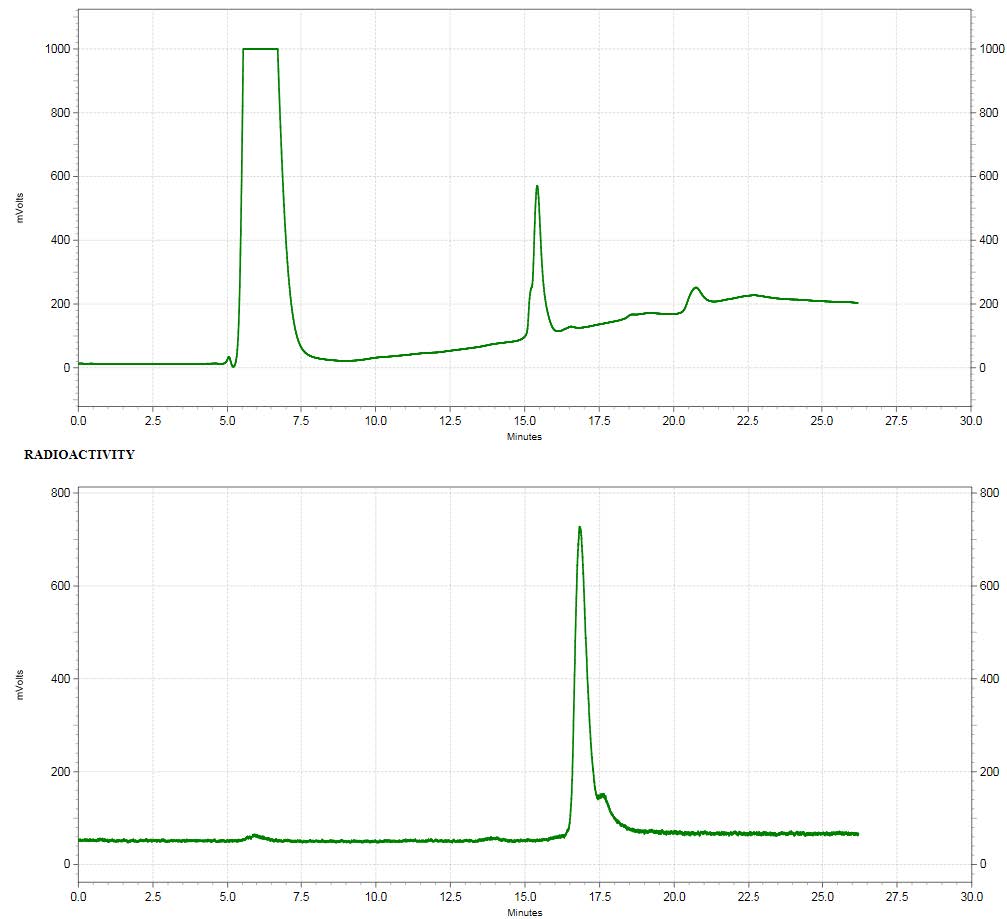
Preparative reverse-phase HPLC of [125I]angiotensin II on a C18 column (35% to 80% methanol, 0.1% TFA, 0.4 mL/min). The unlabeled peptide, seen by UV (top chromatogram), elutes at about 15.5 minutes. The radioiodinated peptide elutes slightly later, near 17 minutes (bottom chromatogram). The HPLC radiochromatogram for your preparation is included in the study report.
Labeling Strategies
Iodogen® Radioiodination Reagent
Iodogen radioiodination is our preferred method for most target classes. It labels tyrosine, and to a lesser extent histidine, residues across a range of proteins, antibodies and peptides. This method is fast, gentle, and your molecule is never exposed to oxidant in solution.
Lactoperoxidase Radioiodination
Lactoperoxidase radioiodination is the preferred method for oxidation-sensitive, flexible or methionine-containing peptides. It is the mildest of the direct methods and oxidises iodide-[125I] to its reactive form using hydrogen peroxide. It avoids using stronger oxidants that would risk oxidising sensitive residues.
Reaction with [125I]Bolton-Hunter Reagent
When a protein has no accessible tyrosine, or when iodinating a tyrosine would disturb the binding interface, we conjugate the [125I]Bolton-Hunter reagent to a primary amine instead. The radioiodinated phenolic group attaches through a lysine side chain or the N-terminus and we first check that the modified residue is not itself required for binding.
Tritium Labeling
Custom synthesis of tritium labeled small molecules is performed through our specialist partner, Novandi Chemistry AB. The resulting specific activity of the custom tritiated small molecule is sufficient for most receptor binding assays.
Choosing the Right Route
Your Molecule | Method |
| Protein or peptide with an accessible tyrosine | Iodogen |
| Flexible or oxidation-sensitive peptide (e.g. methionine present) | Lactoperoxidase |
| No accessible tyrosine, or tyrosine sits in the binding site | Bolton-Hunter, via a lysine amine |
| Small molecule | Tritium (Novandi) |
What We Need from You
- For peptides and proteins, 0.2 to 0.5 mg of the unlabeled peptide.
- For small molecules (tritium labeling), a suitable precursor.
A short conversation is usually enough to recommend a radiolabeling approach for your desired tracer and to collaboratively design follow-on radioligand binding assays for your target receptor. Get in touch today to ask one of our scientists directly.
Frequently Asked Questions about Radiolabeling
What specific activity can you achieve?
Mono-iodinated peptides purified by HPLC approach the carrier-free maximum, approximately 2200 Ci/mmol. The specific activity of proteins purified by dialysis is variable but is generally > 300 Ci/mmol. Tritiated small molecules reach moderate specific activities (typically 30 – 80 Ci/mmol) that are sufficient for most receptor binding assays.
Do you confirm the radiolabel has not affected receptor binding?
This can be readily performed by running a radioligand binding assays using the radiolabeled material and the target receptor.
Do you run the assays, as well as the labeling?
Yes. We only label peptides and small molecules for use in our radioligand binding, receptor occupancy and autoradiography assays. Iodine labeling and assays are all performed on one site, so loss of specific activity is minimised.
Do you label small molecules?
We work with our specialist partner, Novandi Chemistry AB, for custom tritum labeling of small molecules. A suitable precursor may need to be provided. Once labeled, the tritiated product needed for our assays is shipped to us directly, with the majority kept in reserve by Novandi for later use and/or periodic purity checks.
Gifford Bioscience is a full-service receptor pharmacology CRO. We design assays collaboratively, troubleshoot difficult targets, and label, validate and deploy tracers in-house. Tell us what you want to label and the assay you have in mind, and we will recommend and walk you through the best approach for your tracer.
Get in Touch