
Receptor Autoradiography
Receptor autoradiography is a quantitative imaging technique used to identify and map binding sites for a labelled drug in a tissue or organ section. Autoradiography preserves the spatial architecture that homogenate binding assays cannot, providing region-level resolution of receptor density, ligand affinity and off-target binding, in a single experiment.
At Gifford Bioscience, receptor autoradiography is run on cryostat-cut sections of frozen human or untreated animal tissue. We offer in vitro autoradiography for receptor characterisation and competition studies, and ex vivo autoradiography for receptor occupancy determination from drug-treated animals.

We use Bright cryostat for precision sectioning of fresh-frozen tissue, enabling the thin, well-preserved sections essential for high-resolution receptor autoradiography.
What Is Receptor Autoradiography Used For?
In vitro autoradiography. Using sections cut from frozen untreated human or animal tissue, in vitro autoradiography measures the affinity of an unlabeled drug by competing with the binding of a radiolabeled drug to the target receptor. In vitro autoradiography can also identify off-target binding sites, by revealing residual binding in knockout animal tissue, or in regions where the target receptor is not expressed.
Ex vivo autoradiography, performed on tissue from drug-treated animals, determines the receptor occupancy of the drug at the time of tissue collection. Because the technique localizes binding to anatomically defined regions, it reveals heterogeneity that whole-tissue homogenate binding misses, such as differential occupancy between the different brain regions (e.g., cortex, hippocampus, cerebellum).
For human tissue use, ethics committee approval is required. Gifford Bioscience manages the application process to obtain the tissue from an accredited UK tissue bank.
Example Data
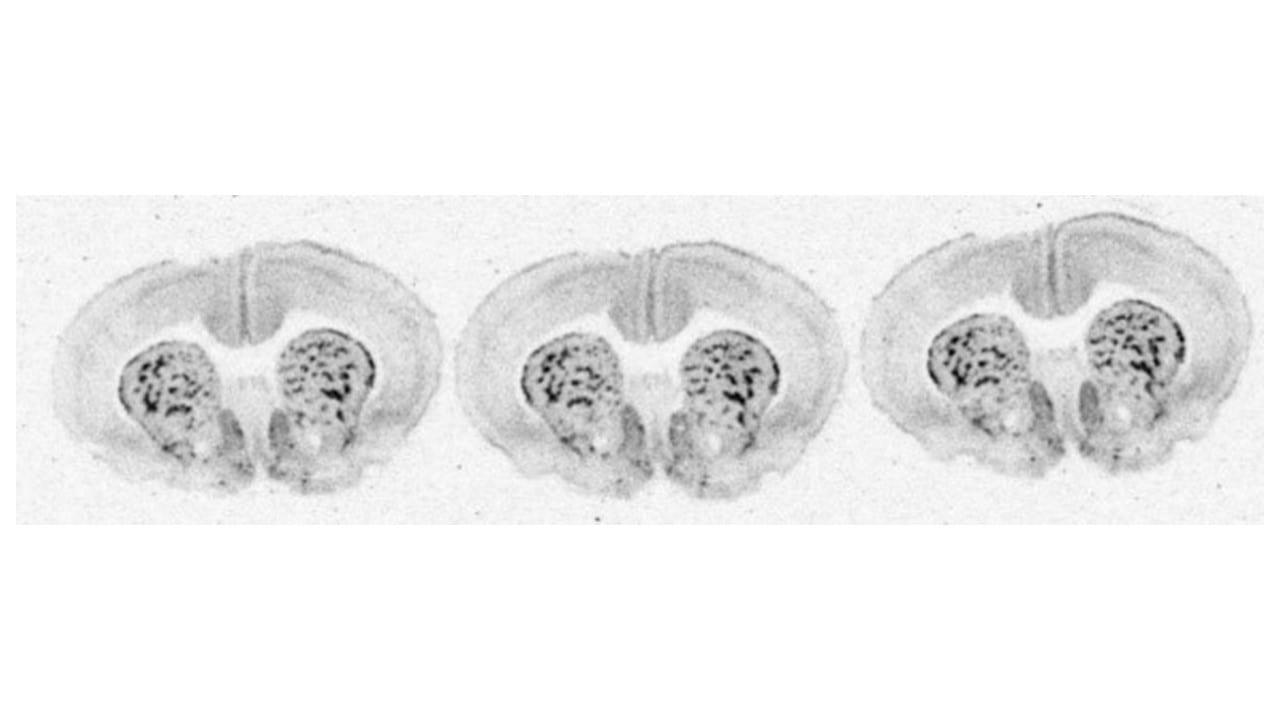
Binding of [3H]DAMGO to µ opioid in coronal sections at the level of the corpus striatum in a rat brain.
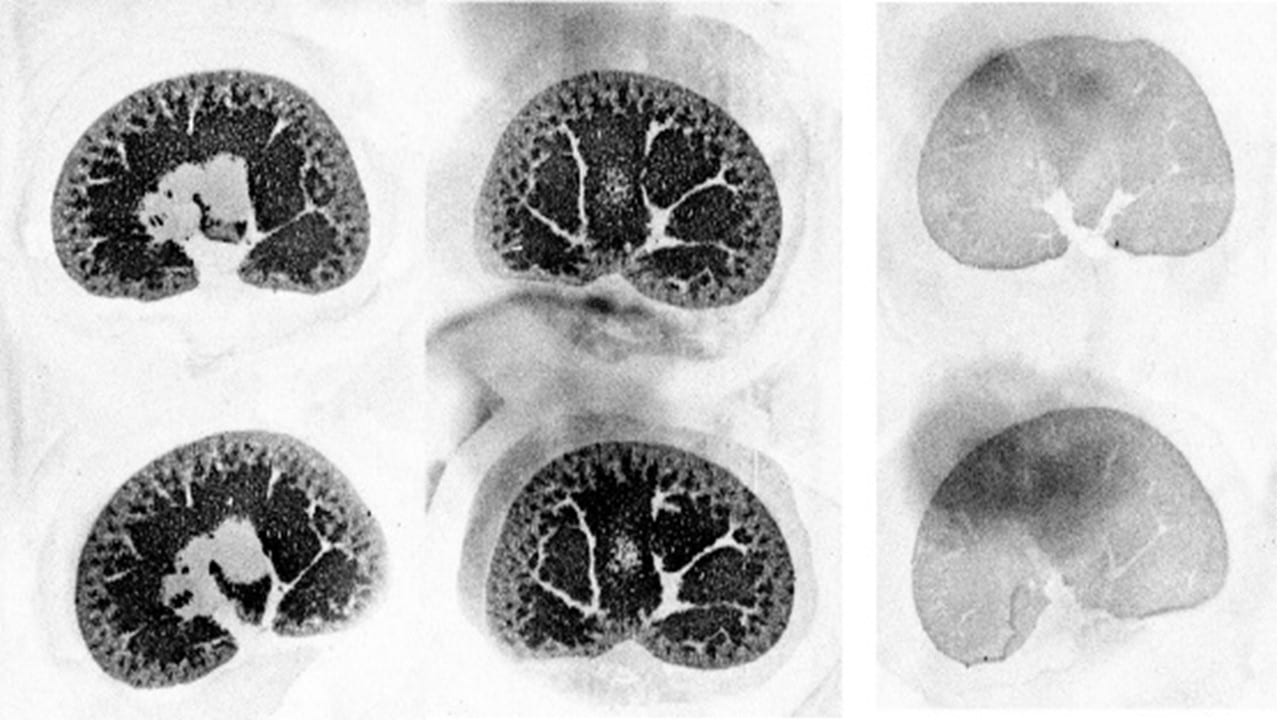
Binding of [3H]LRRK2-IN-1 to the LRRK2 enzyme in rat kidney. Sections in the centre and to the left are total binding. The two sections on the right are non-specific binding, defined using unlabeled LRRK2-IN-1 (10 µM).
When to Choose Autoradiography over Homogenate Radioligand Binding?
Homogenate radioligand binding is the right tool for affinity, density and competition measurements, averaged across a tissue. Receptor autoradiography is the right tool when spatial information matters, such as:
- regional receptor distribution mapping;
- identification of off-target binding sites;
- ex vivo receptor occupancy;
- work in low-abundance regions where homogenate dilution would lose signal;
- translational studies, where preserving anatomy is essential for read-across to in vivo imaging.
- The two approaches are often used in combination, with homogenate binding establishing affinity and autoradiography confirming spatial selectivity.
The two approaches are often used in combination, with homogenate binding establishing affinity and autoradiography confirming spatial selectivity.
Autoradiography Protocol
Cryostat-cut tissue sections are incubated with the radiolabelled drug until equilibrium is reached. The sections are washed in fresh buffer to remove unbound radiotracer, dried and imaged using quantitative phosphorimaging. Regions-of-interest (ROIs) are then drawn over each imaged section and radioactivity levels are measured. Even small regions, smaller than 100 μm, can be quantified.
Non-specific binding is defined on adjacent sections using an excess of unlabelled competitor. Specific binding is calculated by subtraction. Calibrated standards co-imaged on the same phosphor screen convert phosphorimage signal to fmol of bound radioligand per mg of tissue, allowing direct comparison across regions, tissues and studies.
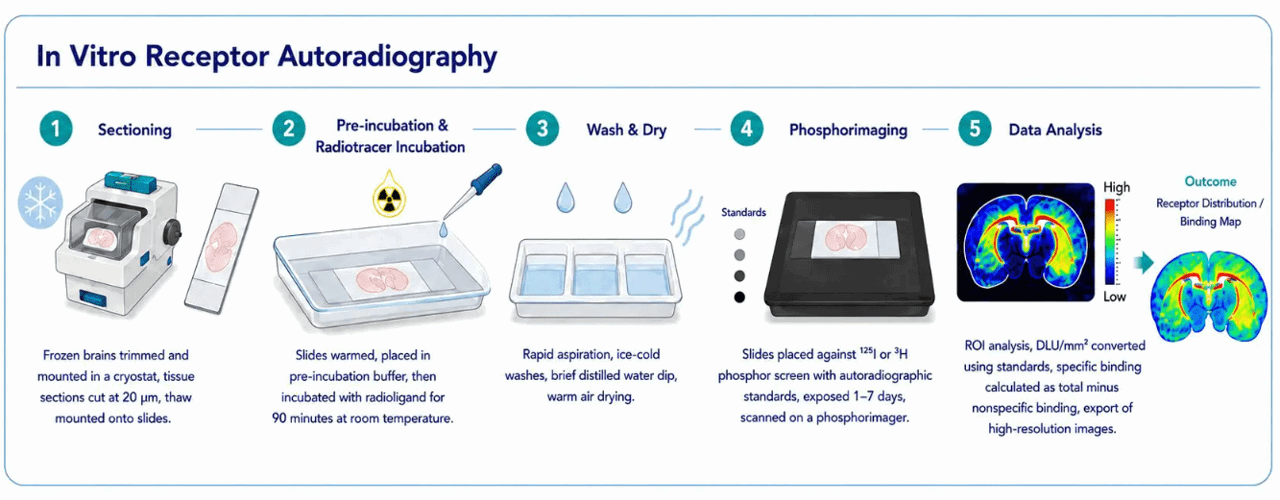
The Gifford autoradiography workflow, from cryostat sectioning through radioligand incubation, washing, phosphorimaging and ROI-based quantification. The in vitro route maps receptor distribution and binding; the ex vivo route measures receptor occupancy in tissue from drug-treated animals.
Applications across Target Classes
Receptor autoradiography is target-class agnostic. Any binding site that can be labelled with a selective radioligand can be mapped and quantified, including GPCRs, ligand-gated and voltage-gated ion channels, transporters, enzymes, and aggregated proteins such as tau, amyloid-β and α-synuclein. The same workflow applies in each case, with the radioligand and incubation conditions tailored to the target.
Frequently Asked Questions about Receptor Autoradiography
What radioisotopes are used?
Can autoradiography detect off-target binding?
Yes. Residual binding in knockout animal tissue, or in regions where the target receptor is not expressed, indicates binding to a non-target site. This is one of the strongest applications of the technique because off-target effects often produce regional binding signatures that homogenate binding cannot resolve.
Can receptor autoradiography be used for ion channels?
Yes. Both ligand-gated and voltage-gated ion channels can be mapped by autoradiography using subtype-selective radioligands.
Examples include:
- nicotinic acetylcholine receptors using tritiated epibatidine or α-bungarotoxin;
- NMDA receptors using [3H]MK-801;
- GABA-A receptors using [3H]muscimol or [3H]flunitrazepam;
- voltage-gated sodium channels using [3H]saxitoxin.
The same protocol applies, with incubation conditions, buffer composition and non-specific binding controls optimised for the channel class.
Can autoradiography be used for tau, amyloid-β and other protein aggregates?
Yes. Autoradiography on post-mortem human brain sections is a standard step in the validation of PET tracers for tau, amyloid-β and α-synuclein, because it confirms binding to pathological aggregates in the disease tissue itself rather than to recombinant protein or transfected cell lines. Tritiated analogues of clinical-stage PET tracers are used, with non-specific binding defined by an excess of unlabelled competitor and adjacent sections often stained immunohistochemically to confirm co-localisation with the pathology. The same approach extends to other aggregated or misfolded protein targets including TDP-43 and huntingtin.
What tissues can be used?
Frozen brain, kidney, lung, liver, heart and peripheral tissue from rodents, NHP and human donors. Human tissue is obtained from an accredited UK tissue bank following ethics committee approval, which Gifford Bioscience coordinates.
How is autoradiographic data quantified?
Phosphor screen signal is converted to fmol of bound radioligand per mg of tissue using co-exposed calibrated standards. Regions-of-interest are drawn over anatomically defined areas and reported as mean signal with non-specific binding subtracted. Data can be expressed as receptor density, percentage of control binding or percentage occupancy as needed.
Can binding kinetics be studied by autoradiography?
Time-course experiments are routine. Sections are incubated for varying times to characterise association, and excess unlabelled competitor is added at defined times to follow dissociation, with quantification by phosphorimaging at each timepoint.
How does autoradiography compare with PET and SPECT?
PET and SPECT are non-invasive in vivo techniques used in living animals and humans, but with limited spatial resolution. Autoradiography is performed on tissue sections ex vivo, with much higher spatial resolution, and is often used to validate or interpret in vivo imaging data with a matched radioligand.
Get in Touch



Copyright © 2026 Gifford Bioscience Limited
Privacy Policy