
Receptor Occupancy
Receptor Occupancy and Target Engagement
Receptor occupancy assays measure the percentage of target receptors bound by a therapeutic drug in animal tissue. They are used to confirm target engagement and guide pharmacokinetics/pharmacodynamics. The assay provides a relatively direct readout of target engagement, to help answers the question:
“How much drug does it take to occupy a sufficient amount of receptors to matter?”
Gifford Bioscience runs ex vivo and in vivo receptor occupancy assays for both central nervous system (CNS) and peripheral targets. We design the radioligand assay, process and section the tissue, and report the dose-occupancy relationship. This guides subsequent dose selection and PK/PD modelling.
The technique works by producing images of radioactivity in tissue sections, showing both the target receptor’s expression, and the test drug’s occupancy of that target receptor at different doses. Percentage occupancy is then calculated for the specific Regions of Interest.
This is achieved using competition assays, where the drug and a radiotracer compete for the same binding site. The more receptors the drug occupies, the less radiotracer that can bind. This fall in radiotracer signal, relative to vehicle-treated control tissue, indicates the receptor occupancy.
Ex Vivo Receptor Occupancy
In an ex vivo receptor occupancy assay, the test compound is dosed in vivo, then tissue is collected at peak drug levels and frozen. We section the tissue on a cryostat and incubate the sections with a radiotracer for the target. Test compound that was dosed in vivo and has bound within the tissue will block a portion of radiotracer binding
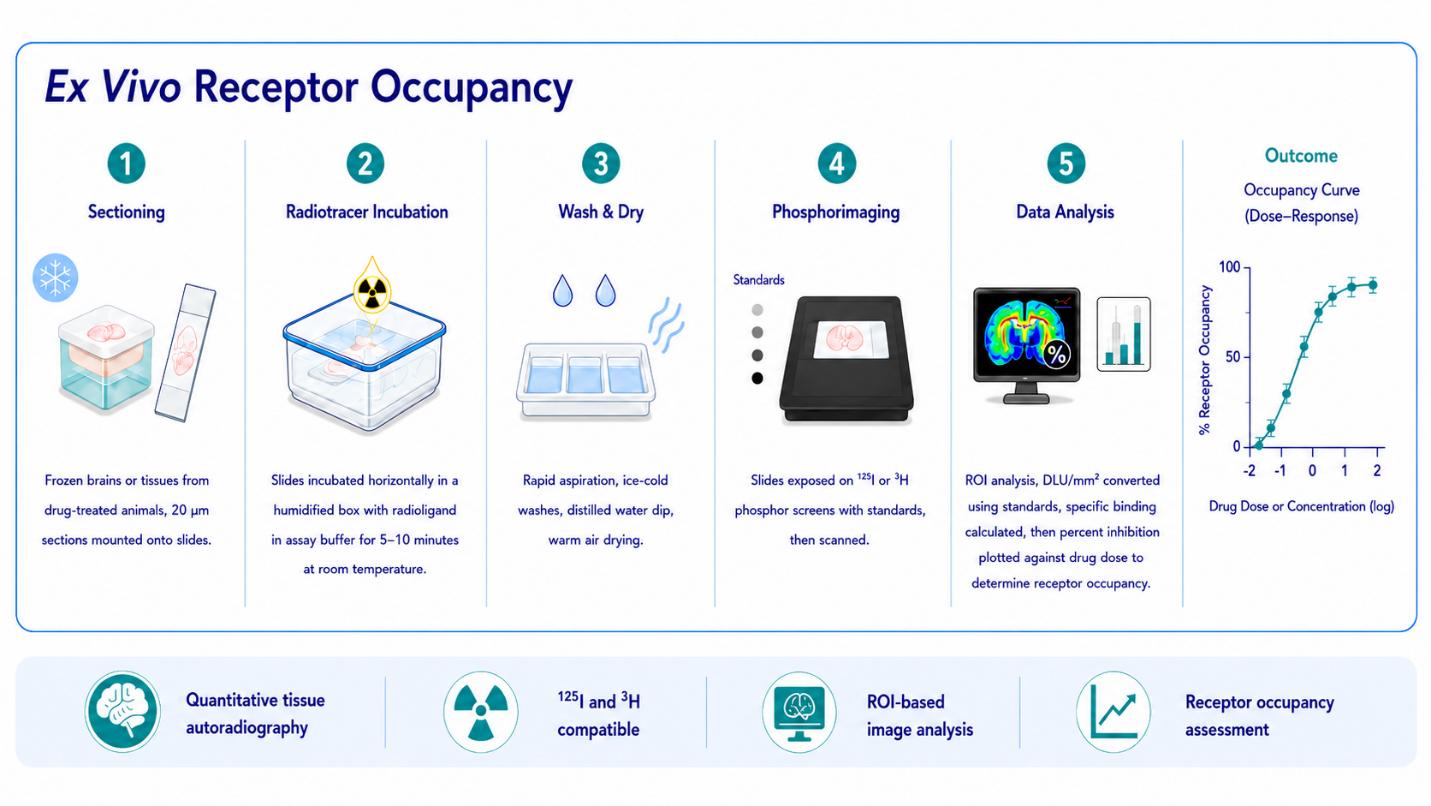
Quantitative autoradiography provides a direct measure of receptor distribution and drug-induced occupancy, linking target engagement to dose and supporting confident dose selection.
Because the radiotracer is applied to tissue sections, ex vivo occupancy resolves target expression and engagement region by region. It shows not just whether a drug reaches the target, but also where that target is expressed.
In Vivo Receptor Occupancy
Where a suitable in vivo radiotracer exists, occupancy can be measured in the live rodent. The test compound is dosed, a radiotracer for the target is given intravenously and tissue is then collected at peak drug levels. We measure the reduction in radiotracer binding caused by the test compound, expressed as the ratio of binding in a receptor-rich region to a reference region.
Built on Validated Radiotracers
Before an occupancy study, if required, we at Gifford Bioscience characterise the radioligand using homogenate binding assays for affinity and binding-site density within the Region of Interest. These pilot assays can also confirm the radioligand specificity, either by pharmacological means or, where available, the use of knockout tissue. Gifford Bioscience has developed and validated novel radiotracers for this purpose, including radioiodinated (through in-house iodination techniques) and tritiated ligands.
Ex vivo Receptor Occupancy Case Study
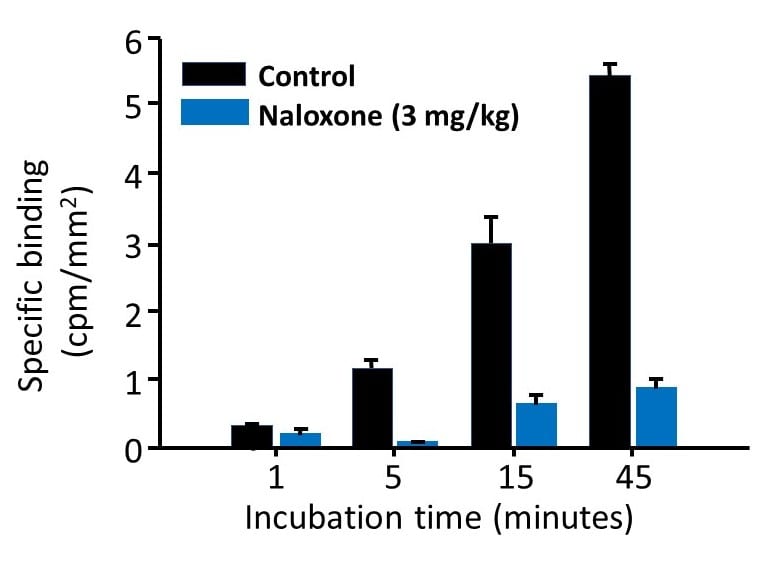
Using autoradiography, the radiolabelled opioid ligand [3H]DAMGO was incubated for different periods of time with striatal sections from an untreated rat (control) and from a rat dosed with the µ receptor antagonist naloxone (3 mg/kg), 20 minutes before sacrifice. Binding of [3H]DAMGO is reduced at all incubation time points in the sections from the treated animal, due to occupancy of µ receptors in the tissue by, naloxone.
In Vivo Receptor Occupancy Case Study
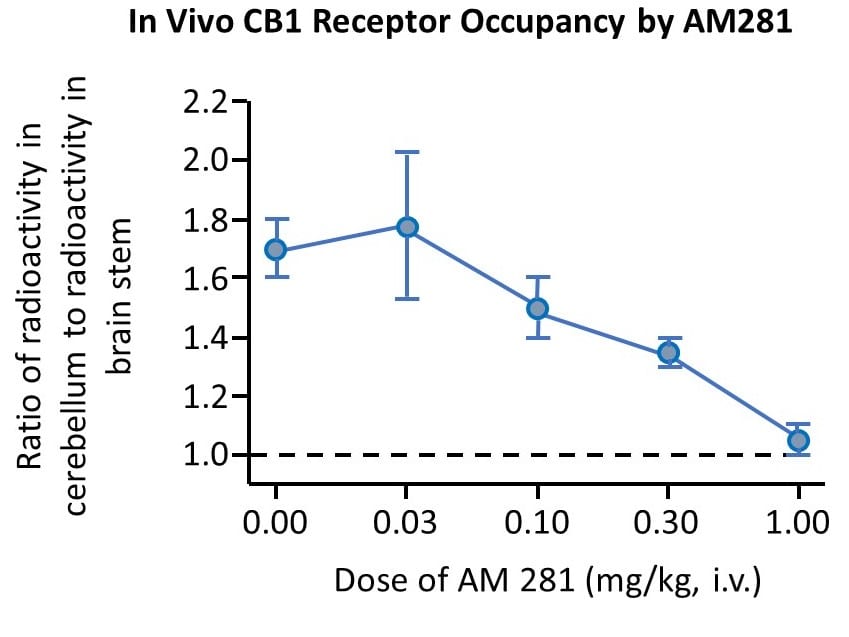
Occupancy of a cannabinoid drug AM281 at CB1 receptors, determined by inhibition of the corresponding radioiodinated tracer. The unlabelled drug reduced specific radiotracer binding by 50%, corresponding to approximately 50% receptor occupancy, at a dose of 0.3 mg/kg. Values are ratios of radioactivity between a CB1 receptor-rich brain region (cerebellum) and a lower-density region (brain stem). The dotted line indicates the level of non-specific binding.
Frequently Asked Questions about Receptor Occupancy
What is a receptor occupancy assay?
A receptor occupancy assay measures the proportion of a target receptor population that a drug binds at a given dose or exposure. It works by competition: the drug and a radiotracer compete for the same binding site, and the reduction in radiotracer binding reports the occupancy. It is thus a relatively direct measure of target engagement in preclinical drug development and can be used to support, or substitute for, pharmacodynamic measurements.
What is the difference between ex vivo and in vivo occupancy?
In an ex vivo assay the rodent is dosed with the test compound, tissue is collected and frozen, and the radiotracer is applied to tissue sections in the laboratory. Ex vivo approaches work when these is a sufficient abundance of the receptor in the tissue to be detected by autoradiography with the radiolabeled ligand. They apply to a wider range of targets than the in vivo approach. In an in vivo assay, both the radiotracer and test compound are administered to the living animal and bind to the receptors in situ. The In vivo approach needs a radiotracer with suitable brain (or organ) uptake. The “visualization” of binding in the live animal is more akin to PET studies for receptor occupancy measurement.
Do you undertake the dosing?
Gifford Bioscience works with partner organisations for animal dosing with the test articles. The frozen tissue from the drug-treated animals is shipped directly to us for ex vivo analysis of receptor occupancy.
Which receptors can you study?
Any receptor with a selective radiotracer can be studied. Gifford Bioscience has a depth of knowledge in CNS targets, including GPCRs, such as the, cannabinoid receptor, CB1, and opioid receptors, as well as transporters such as the dopamine transporter. Where a suitable radiotracer does not yet exist, we advise on its selection or development.
What radioisotopes are used?
Tritium [3H], iodine-125 [125I], Sulphur 35 [35S] and other common laboratory radioisotopes are used for ex vivo work on tissue sections. In vivo occupancy studies are with tritium [3H] only.
Why measure occupancy if I already have a functional readout?
Because occupancy does not always equal drug effect. For some targets most of the receptor population must be engaged before an effect appears; for others, such as the CB1 cannabinoid receptor, an effect is produced at very low occupancy because of a large receptor reserve. Measuring occupancy directly tells you how much target a dose engages, which is what dose selection and PK/PD modelling depend on.
How does receptor occupancy relate to PET?
PET studies can be used to measure receptor occupancy non-invasively in living animals and humans. However, these studies are limited to only those targets where a suitable [11C] or [18F] radiotracer is available. Ex vivo occupancy assays studies can be used with a wider range of targets, using primarily tritiated or radioiodine-labelled probes, but work best when the test drug has a high affinity to the receptor (Kd < 30 nM). This is because of limitations with respect to potential dissociation of the test drug from the receptors during the brief (few minutes only) incubation in the radioligand.
What do you need from me to start?
The target receptor, the test compound, and the intended dosing route and schedule. From there we advise on the assay format, the radiotracer and the controls, coordinate tissue collection with the dosing partner, run the assay and report occupancy against dose or exposure.
Get in Touch



Copyright © 2026 Gifford Bioscience Limited
Privacy Policy