
Additional Service
as part of a core receptor pharmacology study
Custom Radioiodination and Tritium Labeling
We label your peptide, protein or small molecule with iodine-125I, confirm specific binding has been retained, then take it straight into receptor binding, occupancy and autoradiography on the same site. For tritium labelling, we work with a partner company, Novandi Chemistry AB.
We radiolabel proteins, peptides and small molecules for use in our radioligand binding, receptor occupancy and autoradiography assays. Iodine-125 [125I] is introduced onto exposed tyrosine residues to give a high specific activity tracer, well suited to sensitive in vitro and in vivo work. Tritium is used for small molecules, where the labeled compound is chemically and biologically near-identical to the parent and ideal for receptor binding studies.
Because we iodinate in-house, the labeled tracer goes straight from synthesis into the assay. Iodine-125 decays with a 59-day half-life, removing transit time and the resulting loss of specific activity. Tritium labelling is less time sensitive.
A Clean Label. Shown, Not Claimed
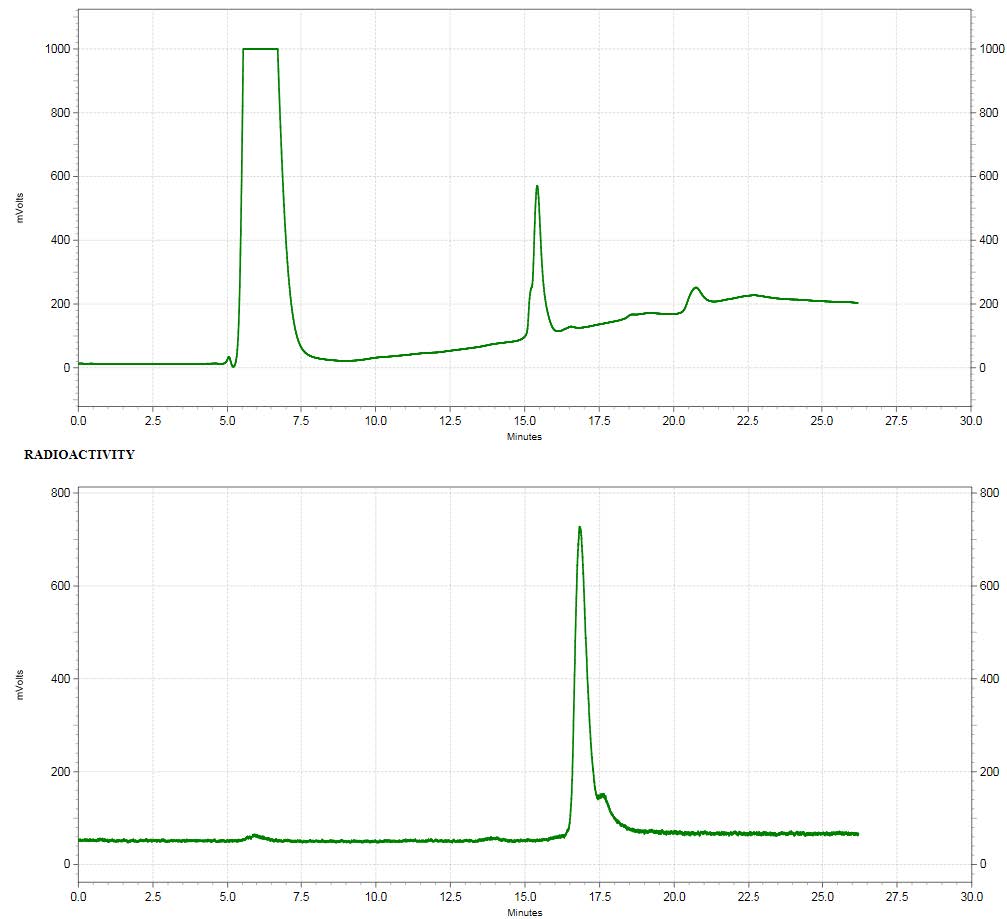
Preparative reverse-phase HPLC of [125I]angiotensin II on a C18 column (35 to 80% methanol, 0.1% TFA, 0.4 mL/min). The unlabeled peptide, seen by UV at 214 nm, elutes at about 15.5 minutes. The radioiodinated peptide elutes slightly later, near 17 minutes, because the added iodine increases lipophilicity and retention on the column. The single dominant radioactive peak is cleanly resolved from unreacted peptide and collected to give a high radiochemical purity tracer. We provide the radiochromatogram for every preparation.
How We Label
Four routes, chosen to preserve the binding behaviour of your molecule.
Iodogen® Radioiodination Reagent
Iodogen is the method we use most. The oxidant is coated on the reaction vessel rather than dissolved with your protein, so the molecule is never exposed to oxidant in solution, and the reaction is stopped simply by removing it from the tube. It is fast, gentle, and tolerant of amine and azide-containing buffers. It labels tyrosine, and to a lesser extent histidine, residues across a wide range of proteins, antibodies and peptides, which makes it our preferred choice for most targets.
Lactoperoxidase Radioiodination
Lactoperoxidase oxidizes iodide-[125I] to its reactive form using hydrogen peroxide. It is the mildest of the direct methods, which makes it our preferred route for flexible or methionine-containing peptides, where stronger oxidants would risk oxidizing sensitive residues.
Reaction with [125I]Bolton-Hunter Reagent
When a protein has no accessible tyrosine, or when iodinating a tyrosine would disturb the binding interface, we conjugate the [125I]Bolton-Hunter reagent to a primary amine instead. The radioiodinated phenolic group attaches through a lysine side chain or the N-terminus. The trade-off is that a lysine is modified, so we check first that the modified residue is not itself required for binding.
Tritium Labeling
We run tritium custom synthesis through our specialist partner Novandi Chemistry AB, with whom we have built a long-working relationship. Small molecules are labelled with tritium at specific activities sufficient for most receptor binding assays. A suitable precursor may need to be provided.
Choosing the Right Route
The starting point is your molecule. We advise on the method most likely to keep it active.
Your Molecule | Method |
| Protein or peptide with an accessible tyrosine | Iodogen |
| Flexible or oxidation-sensitive peptide (e.g. methionine present) | Lactoperoxidase |
| No accessible tyrosine, or tyrosine sits in the binding site | Bolton-Hunter, via a lysine amine |
| Small molecule | Tritium (Novandi) |
Purified, Characterized, Documented
Labeled material is purified by reverse-phase HPLC for peptides and small molecules, or by size-exclusion chromatography for antibodies and proteins. For iodinated peptides, the radioactive product resolves from unlabeled starting material as a single peak, with identity supported by the expected retention shift and, where needed, co-injection of standards. You receive the radiochromatogram for your preparation.
Mono-iodinated peptides approach the carrier-free maximum, near 2,175 Ci/mmol per iodine atom. Radiochemical purity after preparative HPLC is typically greater than 95%. Labeling, purification and assay all take place on one site, thus ensuring a minimal loss in specific activity that would otherwise occur if transported between multiple sites.
We Confirm Target Binding is Retained
A label is only useful if the tracer behaves like the parent, so we validate this in house. Saturation binding using the new tracer determines its Kd and Bmax, so its affinity and receptor density are known before any study begins. The validated tracer then goes straight into assays performed on-site, such as radioligand binding, and autoradiography. You will receive the binding data and the study results.
What We Need from You
- The sequence or structure of the molecule.
- The amount of material available and its purity.
- A small quantity of unlabeled standard for HPLC reference.
- The assay you intend to run, so we label to preserve binding.
A short conversation is usually enough to recommend the best method for your desired tracer. Get in touch today to start your journey with us at Gifford Bioscience.
Frequently Asked Questions about Radiolabeling
Which iodination method will you use?
Most projects use Iodogen® labeling. We switch to lactoperoxidase for flexible or oxidation-sensitive peptides, and to Bolton-Hunter when a protein lacks an accessible tyrosine or when iodinating the tyrosine would interfere with binding.
What specific activity can you achieve?
Mono-iodinated peptides approach the carrier-free maximum, near 2,175 Ci/mmol per iodine atom. Tritiated small molecules reach moderate specific activities that are sufficient for most receptor binding assays.
Do you confirm the radiolabel has not affected receptor binding?
Yes. We measure the Kd and Bmax of the new tracer by saturation binding before it is used, so its affinity and site density are known before proceeding with further assays.
Do you run the assays, as well as the labeling?
Yes. We only label peptides and small molecules for use in our radioligand binding, receptor occupancy and autoradiography assays. Labeling and assays are all performed on one site, so loss of specific activity is minimised.
Do you label small molecules?
For labelling of small molecules with tritium, we work with our specialist partner, Novandi Chemistry AB. A suitable precursor may need to be provided.
Send Us Your Sequence Or Structure
Gifford Bioscience is a full-service receptor pharmacology CRO. We design assays collaboratively, troubleshoot difficult targets, and label, validate and deploy tracers in-house. Tell us what you want to label and the assay you have in mind, and we will recommend and walk you through the best approach for your tracer.
Get in Touch



Copyright © 2026 Gifford Bioscience Limited
Privacy Policy