
5-Hydroxytryptamine (5-HT; serotonin) was first identified in the gastrointestinal tract and subsequently recognised as a major neurotransmitter within the central nervous system (CNS). The serotonergic system originates primarily from the raphe nuclei of the brainstem, with ascending projections innervating virtually every region of the forebrain [2]. In the periphery, the majority of the body’s 5-HT is synthesised by enterochromaffin cells of the gut, where it regulates motility, secretion, and visceral sensation.
The biological actions of 5-HT are mediated through an exceptionally diverse family of receptors. The International Union of Basic and Clinical Pharmacology (IUPHAR) classification recognises 14 distinct 5-HT receptor subtypes, grouped into seven families (5-HT1 through 5-HT7) on the basis of their structural homology, signal transduction mechanisms, and pharmacological profiles [1]. This extraordinary molecular diversity explains the pleiotropic actions of serotonin across organ systems and has provided a rich landscape for therapeutic drug development.
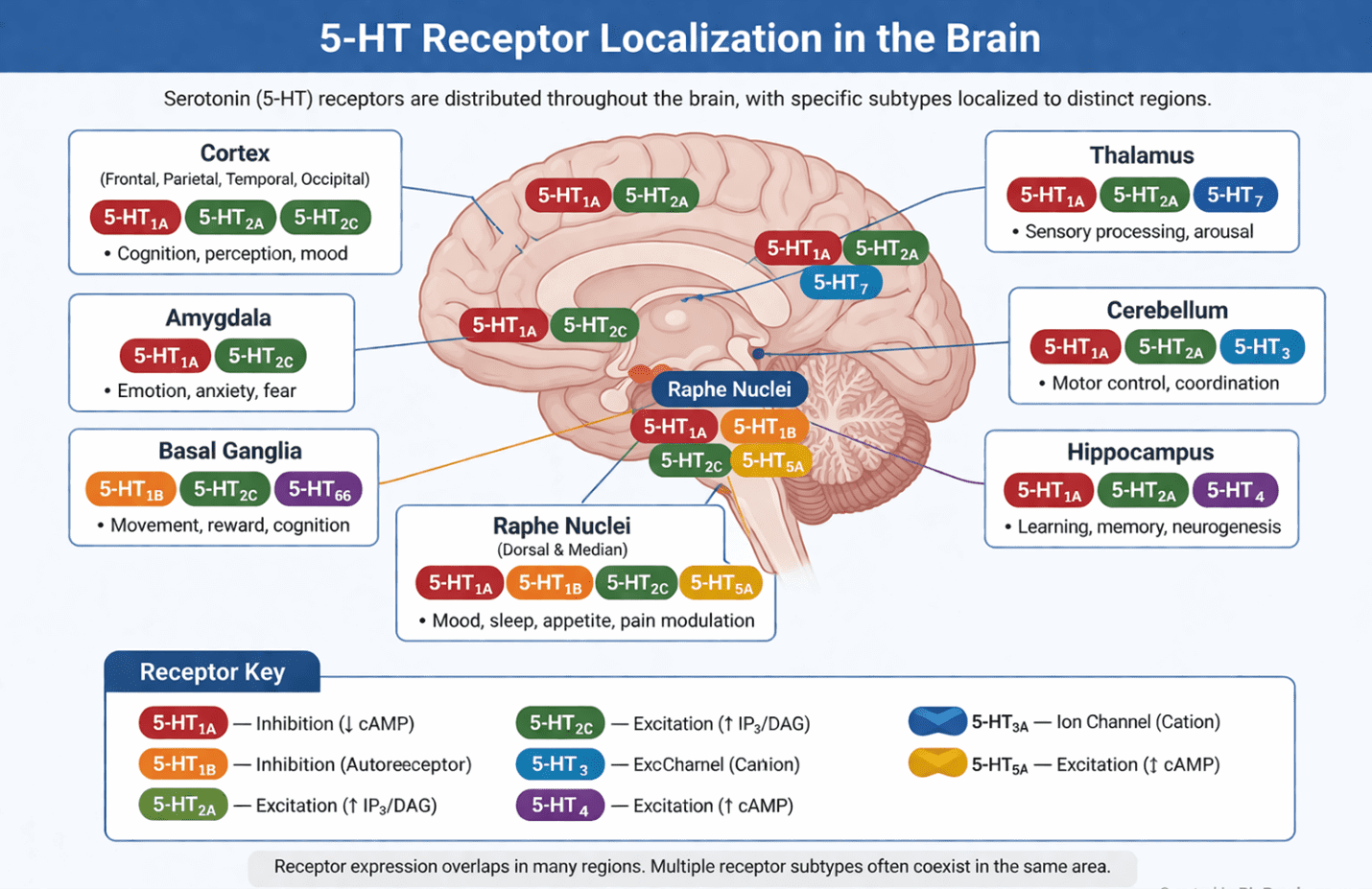

Figure 1 (Receptor localisation) maps the major 5-HT receptor subtypes across brain, vasculature, heart valves, and GI tract. The enterochromaffin cell callout reinforces that the gut is the primary source of peripheral 5-HT. The colour coding matches the G protein coupling families used throughout this article.
How are the 5-HT receptor subtypes classified?
5-HT1 receptors: Gi/o-coupled inhibitory signalling.
Thirteen of the fourteen 5-HT receptor subtypes are GPCRs, characterised by seven transmembrane-spanning domains and signalling through heterotrimeric G proteins. The 5-HT1 receptor family (5-HT1A, 5-HT1B, 5-HT1D, 5-ht1e, 5-HT1F) couples predominantly to Gi/o proteins, leading to inhibition of adenylyl cyclase and a consequent decrease in cAMP production.
The 5-HT1A receptor is one of the best characterised subtypes, functioning as both a somatodendritic autoreceptor on serotonergic neurons in the raphe nuclei, and as a postsynaptic receptor in cortical and limbic regions [3]. The 5-HT1B and 5-HT1D receptors serve as terminal autoreceptors regulating 5-HT release and are also expressed on blood vessels. The triptan class of antimigraine drugs, such as sumatriptan, exert their therapeutic action primarily through agonism at 5-HT1B, 5-HT1D, and 5-HT1F receptors [3].
5-HT2 receptors: Gq/11-coupled calcium signalling.
The 5-HT2 receptor family (5-HT2A, 5-HT2B, 5-HT2C) couples to Gq/11 proteins, activating phospholipase C (PLC) and generating the second messengers inositol trisphosphate (IP3) and diacylglycerol (DAG). This results in intracellular calcium mobilisation and protein kinase C (PKC) activation [4]. The 5-HT2A receptor is widely expressed in the cortex and is the primary target of hallucinogenic compounds. Its antagonism is a feature of atypical antipsychotic drugs such as clozapine and risperidone.
The 5-HT2C receptor is implicated in the regulation of appetite, anxiety, and dopaminergic neurotransmission. The 5-HT2B receptor has received significant attention in safety pharmacology owing to its role in drug-induced cardiac valvulopathy, as observed with fenfluramine and pergolide [5].
5-HT3 receptors: the ligand-gated ion channel.
The 5-HT3 receptor is unique within the serotonin receptor family as it is a ligand-gated cation channel of the Cys-loop superfamily, structurally and functionally related to nicotinic acetylcholine receptors. Activation produces rapid depolarisation via Na⁺ and K⁺ flux. 5-HT3 receptor antagonists, including ondansetron and granisetron, are highly effective antiemetics widely used to manage chemotherapy-induced nausea and vomiting [1].
5-HT4, 5-HT5A, 5-HT6 and 5-HT7 receptors.
The 5-HT4 receptor couples to Gs proteins, stimulating adenylyl cyclase and increasing cAMP. It plays a prominent role in gastrointestinal motility and has been explored as a target for treating cognitive deficits [6]. The 5-HT5A receptor couples to Gi/o. It remains the least characterised subtype. The 5-HT6 receptor, which couples to Gs, is expressed almost exclusively in the CNS and regulates glutamatergic and cholinergic neurotransmission, making it a candidate target for cognitive enhancement in dementia [7]. The 5-HT7 receptor also couples to Gs and is implicated in circadian rhythm regulation, thermoregulation and mood [1].
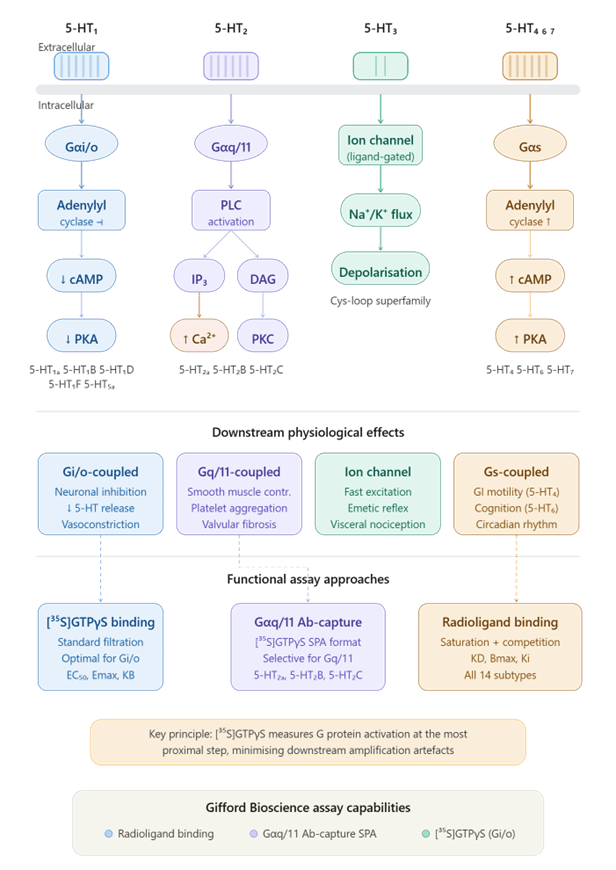
Figure 2 (Signalling pathways) walks the reader visually from receptor activation at the membrane through to second messengers and downstream physiology, covering all four transduction mechanisms (Gi/o, Gq/11, ligand-gated ion channel, Gs). It also ties directly into the assay methodology section by linking each coupling pathway to its matched functional assay platform, with a Gifford capabilities footer in teal and olive green.
Which diseases involve 5-HT receptor dysfunction?
Depression and anxiety.
Dysregulation of serotonergic signalling is a central feature of numerous neuropsychiatric and systemic disorders. In depression, the monoamine hypothesis posits that deficient serotonergic neurotransmission underlies the pathophysiology of the disease. Selective serotonin reuptake inhibitors (SSRIs) remain the first-line pharmacotherapy, and their therapeutic latency is attributed in part to gradual desensitisation of 5-HT1A autoreceptors, thereby disinhibiting serotonergic firing [2, 3]. The 5-HT1A receptor partial agonist buspirone is an established anxiolytic, while the 5-HT2A receptor has emerged as a target for novel rapid-acting antidepressants, including psilocybin [1].
Schizophrenia.
In schizophrenia, the interaction between 5-HT2A and dopamine D2 receptor antagonism defines the pharmacological profile of atypical antipsychotics. Combined 5-HT2A/D2 blockade is associated with improved negative symptoms and reduced extrapyramidal side effects compared with typical antipsychotics [4].
Migraine.
In migraine, the triptans exert their vasoconstrictive and antinociceptive effects through 5-HT1B/1D receptor activation, whilst the newer ditans (e.g. lasmiditan) act selectively at 5-HT1F receptors without vasoconstriction [3].
Irritable bowel syndrome and GI disorders.
In irritable bowel syndrome (IBS), 5-HT3 receptor antagonists such as alosetron reduce diarrhoea-predominant symptoms, whereas the 5-HT4 agonist prucalopride is used to treat chronic constipation [1, 6].
5-HT2B receptor agonism and cardiac valvulopathy: a safety pharmacology concern.
A particularly important safety pharmacology concern is the association between 5-HT2B receptor agonism and drug-induced cardiac valvulopathy. Sustained agonist stimulation of valvular 5-HT2B receptors promotes pro-fibrotic signalling through the Gq/11–PLC pathway and downstream mitogenic cascades including mitogen-activated protein kinase (MAPK) activation. This was famously observed with fenfluramine (used in obesity) and with ergot-derived dopamine agonists pergolide and cabergoline used in Parkinson’s disease. As a consequence, screening for 5-HT2B receptor agonist activity is now a standard component of preclinical safety pharmacology profiling for drug candidates [5]. Specialist receptor pharmacology CROs, such as Gifford Bioscience, offer dedicated 5-HT2B functional assay services to support this critical safety assessment.
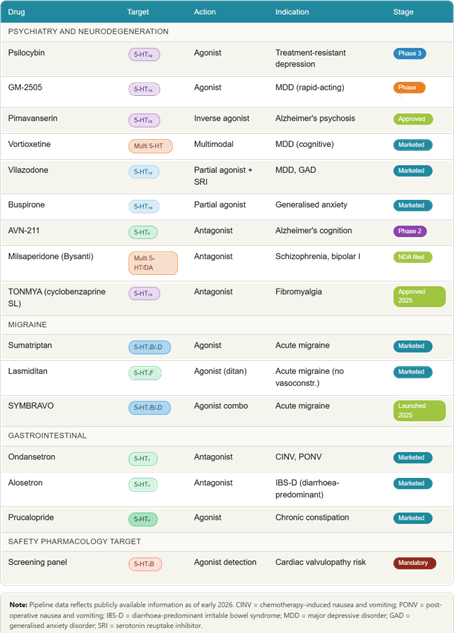
Figure 3 (Clinical pipeline table) grounds the pharmacology in real therapeutic context, organised by disease area. It includes recent pipeline entries like GM-2505, a novel 5-HT2A agonist being developed for MDD that showed an acceptable safety profile in a Phase 1 healthy volunteer study Sage Journals, milsaperidone (Bysanti), which has an NDA filed with an FDA target decision date of February 2026 for schizophrenia and bipolar I Synapse, and TONMYA (cyclobenzaprine sublingual), approved in August 2025 as the first new fibromyalgia treatment in over 15 years, acting as a 5-HT2A antagonist Tonixpharma. The 5-HT2B safety screening row at the bottom ties into the valvulopathy discussion in this article.
How are 5-HT receptors characterised? Radioligand binding assays.
Radioligand binding assays are the cornerstone methodology for quantifying receptor affinity, density (Bmax), and selectivity of compounds at 5-HT receptors. In a typical saturation binding experiment, increasing concentrations of a radiolabelled ligand are incubated with membrane preparations expressing the target receptor, allowing determination of the equilibrium dissociation constant (KD) and Bmax. Competition (displacement) binding assays are used to determine the inhibition constant (Ki) of unlabelled test compounds by measuring their ability to displace a fixed concentration of radioligand from the receptor [8].
Historically, the identification and classification of 5-HT receptor subtypes relied heavily upon radioligand binding with tritium-labelled compounds. The pioneering autoradiographic studies of Palacios and colleagues employed [3H]5-HT, [3H]8-OH-DPAT (selective for 5-HT1A), [3H]LSD, and [3H]mesulergine (selective for 5-HT1C/2C) to provide the first detailed maps of 5-HT1 receptor subtype distribution in the rat brain [8].
With the molecular cloning of all 14 subtypes, recombinant cell lines expressing individual human 5-HT receptor subtypes have become the standard membrane source for screening compound libraries. Commonly used radioligands include [3H]WAY-100635 for 5-HT1A, [3H]ketanserin for 5-HT2A, [3H]GR113808 for 5-HT4, and [3H]SB-269970 for 5-HT7 receptors [1]. Whilst radioligand binding provides essential information on affinity and selectivity, it does not distinguish between agonists, antagonists, and inverse agonists, necessitating complementary functional assay approaches.
What is the [35S]GTPγS binding assay and why use it for 5-HT receptors?
The [35S]GTPγS binding assay is a widely employed functional assay that measures receptor-mediated G protein activation at one of the earliest steps in the GPCR signalling cascade [9]. The assay exploits the normal GTP-GDP exchange cycle that occurs upon agonist binding to a GPCR. Under physiological conditions, agonist occupation of the receptor catalyses the exchange of GDP for GTP on the Gα subunit, causing dissociation of the heterotrimer and downstream effector modulation. In the assay, the non-hydrolysable GTP analogue [35S]GTPγS replaces endogenous GTP, becoming irreversibly incorporated into activated Gα subunits. The accumulated [35S]GTPγS is then quantified by scintillation counting or scintillation proximity assay [9, 10].
A key advantage of the [35S]GTPγS assay is that it measures a functional consequence of receptor occupancy at a proximal point in the signalling pathway, meaning that results are relatively unaffected by downstream signal amplification or modulation of effector coupling. This enables the determination of intrinsic efficacy (ε) with greater resolution than distal assays. The assay allows determination of traditional pharmacological parameters including agonist potency (EC50), maximal response (Emax), and antagonist affinity (KB) [9, 10].
The standard [35S]GTPγS binding assay is most readily applied to Gi/o-coupled receptors, owing to the high relative abundance of Gi/o proteins in most membrane preparations, producing a favourable signal-to-noise ratio. For the 5-HT receptor family, this renders the assay particularly well-suited for characterising 5-HT1A, 5-HT1B, 5-HT1D, and 5-HT5A receptors, all of which couple through Gi/o. The assay can also be applied to Gs– and Gq-coupled receptors, but with reduced sensitivity in native tissues due to the lower abundance of these G protein subtypes [9].
How does the Gq/11 antibody-capture [35S]GTPγS SPA work?
For Gq/11-coupled 5-HT receptors – notably the 5-HT2A, 5-HT2B, and 5-HT2C subtypes – the conventional [35S]GTPγS assay often lacks sufficient sensitivity because the total [35S]GTPγS signal is dominated by constitutive loading onto the more abundant Gi/o family. The Gαq/11 antibody-capture [35S]GTPγS scintillation proximity assay (SPA) overcomes this by selectively immunoprecipitating activated Gαq/11 subunits following [35S]GTPγS incorporation [11, 12].
In this approach, membranes are incubated with agonist in the presence of [35S]GTPγS and GDP under optimised conditions for Mg2+ and NaCl concentrations. Following the binding reaction, a selective anti-Gαq/11 antibody is added to immunoprecipitate specifically those Gαq/11 subunits that have incorporated [35S]GTPγS. This immunocomplex is then captured using Protein A-coated SPA beads, bringing the [35S]GTPγS into close proximity with the scintillant-containing bead, producing a measurable signal without the need for filtration or wash steps. Crucially, [35S]GTPγS bound to non-target G proteins (e.g. Gi/o) is not immunoprecipitated and therefore does not contribute to the detected signal, dramatically improving specificity [11, 12].
Salah-Uddin et al. (2008) demonstrated the utility of this approach in native human brain tissue, quantifying M1 muscarinic receptor–Gαq/11 coupling in postmortem cerebral cortex and distinguishing full from partial agonists by their intrinsic activity [12]. Odagaki and Toyoshima (2012) extended this methodology to rat brain membranes, optimising antibody dilution, GDP, and ionic conditions to achieve reproducible agonist-stimulated [35S]GTPγS binding to Gαq with regional sensitivity reflecting receptor density [11].
The Gαq/11 antibody-capture SPA/[35S]GTPγS assay thus provides a powerful functional readout for Gq-coupled 5-HT receptors in both recombinant and native tissue preparations. By selectively interrogating the Gαq/11 pathway, it complements conventional [35S]GTPγS binding for Gi/o-coupled subtypes and alternative functional readouts such as intracellular calcium mobilisation, IP1/IP3 accumulation, and reporter gene assays.
Summary: a pharmacological toolkit for serotonergic drug discovery.
The 5-HT receptor family represents one of the most pharmacologically and therapeutically significant target families in biomedical science. The 14 subtypes exhibit remarkable diversity in G protein coupling, tissue distribution, and physiological function, and their dysregulation contributes to pathologies spanning psychiatry, neurology, cardiology, and gastroenterology.
Radioligand binding assays remain indispensable for determining receptor affinity and selectivity, while the [35S]GTPγS binding assay provides a proximal, amplification-free measure of receptor activation at Gi/o-coupled subtypes. For Gq/11-coupled receptors, including the clinically important 5-HT2A, 5-HT2B, and 5-HT2C subtypes, the Gαq/11 antibody-capture [35S]GTPγS SPA offers a selective, sensitive, and high-throughput functional readout. Together, these complementary methodologies provide a robust pharmacological toolkit for the discovery and safety assessment of serotonergic therapeutics.
Need expert 5-HT receptor pharmacology support for your drug discovery programme?
From 14-subtype selectivity screens to 5-HT2B safety liability testing, we offer a complete pharmacological toolkit. We work across both recombinant cell lines and native tissue preparations to ensure your data reflects the biological reality of your target. Let us handle the assay development and validation so your team can focus on the next lead.
Get a quote for your 5-HT programme.
Get in touch: enquiries@giffordbio.com | www.giffordbio.com
References
[1] Barnes NM, Ahern GP, Becamel C, Bockaert J, et al. International Union of Basic and Clinical Pharmacology. CX. Classification of Receptors for 5-hydroxytryptamine; Pharmacology and Function. Pharmacol Rev. 2021;73(1):310–520. DOI: 10.1124/pr.118.015552
[2] Graeff FG. Serotonergic systems. Psychiatr Clin North Am. 1997;20(4):723–739. DOI: 10.1016/s0193-953x(05)70342-7
[3] Lanfumey L, Hamon M. 5-HT1 receptors. Curr Drug Targets CNS Neurol Disord. 2004;3(1):1–10. DOI: 10.2174/1568007043482570
[4] Leysen JE. 5-HT2 receptors. Curr Drug Targets CNS Neurol Disord. 2004;3(1):11–26. DOI: 10.2174/1568007043482598
[5] Cavero I, Guillon JM. Safety Pharmacology assessment of drugs with biased 5-HT(2B) receptor agonism mediating cardiac valvulopathy. J Pharmacol Toxicol Methods. 2014;69(2):150–161. DOI: 10.1016/j.vascn.2013.12.004
[6] Bockaert J, Claeysen S, Compan V, Dumuis A. 5-HT4 receptors. Curr Drug Targets CNS Neurol Disord. 2004;3(1):39–51. DOI: 10.2174/1568007043482615
[7] Woolley ML, Marsden CA, Fone KCF. 5-ht6 receptors. Curr Drug Targets CNS Neurol Disord. 2004;3(1):59–79. DOI: 10.2174/1568007043482561
[8] Palacios JM. Serotonin receptors in brain revisited. Brain Res. 2016;1645:46–49. DOI: 10.1016/j.brainres.2015.12.042
[9] Harrison C, Traynor JR. The [35S]GTPgammaS binding assay: approaches and applications in pharmacology. Life Sci. 2003;74(4):489–508. DOI: 10.1016/j.lfs.2003.07.005
[10] Strange PG. Mechanisms underlying agonist efficacy. Biochem Soc Trans. 2007;35(Pt 4):733–736. DOI: 10.1042/BST0350733
[11] Odagaki Y, Toyoshima R. Muscarinic acetylcholine receptor-mediated activation of Gq in rat brain membranes determined by [35S]GTPyS binding using an anti-G protein scintillation proximity assay. J Neural Transm. 2012;119(5):525–532. DOI: 10.1007/s00702-011-0742-2
[12] Salah-Uddin H, Thomas DR, Davies CH, et al. Pharmacological assessment of M1 muscarinic acetylcholine receptor-Gq/11 protein coupling in membranes prepared from postmortem human brain tissue. J Pharmacol Exp Ther. 2008;325(3):869–874. DOI: 10.1124/jpet.108.137968
[13] Millan MJ, Cussac D, Gobert A, et al. S32504, a novel naphtoxazine agonist at dopamine D3/D2 receptors: I. Cellular, electrophysiological, and neurochemical profile in comparison with ropinirole. J Pharmacol Exp Ther. 2004;309(3):903–920. DOI: 10.1124/jpet.103.062398